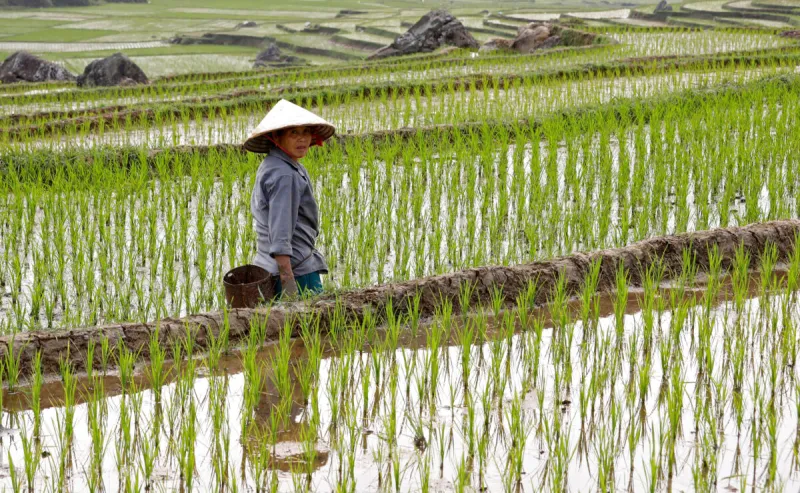
Rice is a cornerstone of Vietnamese life, feeding the vast majority of the country's population and supporting the livelihoods of millions of smallholder farmers, particularly in the Mekong Delta. Yet rice cultivation — through flooded paddies that produce methane and the heavy use of nitrogen fertilisers that release nitrous oxide — is also a significant source of greenhouse gas emissions, creating a difficult policy challenge for Hanoi.
Vietnam's rice paddies are among the largest sources of agricultural methane in Southeast Asia. Flooded rice fields create anaerobic conditions in which organic matter decomposes and releases methane, a potent greenhouse gas. According to estimates cited by Vietnamese government and international agricultural bodies, rice cultivation accounts for a substantial share of the country's total agricultural emissions, which themselves represent a major portion of Vietnam's national greenhouse gas inventory.
To address this, Vietnam has promoted the "1 Must, 5 Reductions" (1M5R) protocol and, more recently, the Sustainable Rice Platform (SRP) standard, which encourage farmers to reduce water use through alternate wetting and drying (AWD) techniques, cut fertiliser and pesticide inputs, and lower seed density. These practices can reduce methane emissions by up to 30–50 per cent per crop cycle while also lowering production costs. The Mekong Delta region has been a key focus, given that it produces the majority of Vietnam's rice exports.
However, adoption remains uneven. Many smallholder farmers are reluctant to change long-established practices without clear financial incentives. The upfront costs of transitioning, combined with uncertainty over carbon credit revenues and premium market access, mean that the economic case for sustainable rice farming is not yet compelling enough for most growers. International carbon markets and green premium buyers have shown interest, but robust, farmer-accessible payment mechanisms remain underdeveloped.
Vietnam has set ambitious climate targets under its updated Nationally Determined Contribution (NDC) and has committed to reducing agricultural emissions as part of its broader net-zero goals. Experts and advocacy groups argue that closing the incentive gap — through direct payments, guaranteed price premiums for low-emission rice, and stronger government support programmes — will be essential if Vietnam is to reconcile its food security imperatives with its climate commitments.