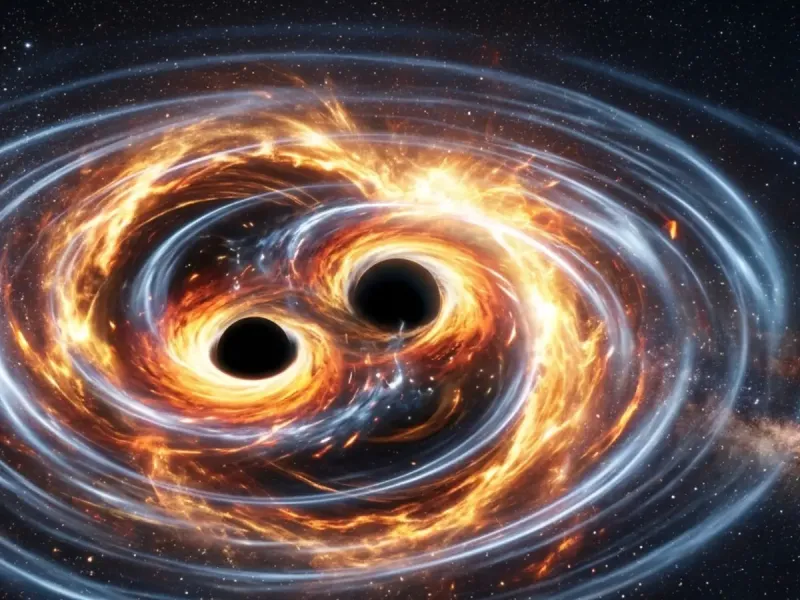
Two supermassive black holes, located about 500 million light-years away in the galaxy SDSS J1430+2303, are on a collision course and are expected to merge in approximately 100 years, according to a study published in Astronomy & Astrophysics in 2025. The black holes have a combined mass of about 200 million suns and are separated by only 200 light-years, making them the closest known pair of supermassive black holes.
Study co-author Silke Britzen, an astrophysicist at the Max Planck Institute for Radio Astronomy, told BBC Science Focus that the merger will produce powerful gravitational waves. However, she emphasized that Earth is not at risk from this event. The gravitational waves will be extremely weak by the time they reach our planet, and any potential effects, such as slight spacetime distortions, are far below detectable levels.
The discovery was made using data from the Very Long Baseline Array (VLBA) and the Sloan Digital Sky Survey. The black holes are orbiting each other at a speed of about 1,000 kilometers per second, and their merger will release energy equivalent to the mass of 100 million suns.
This event provides a unique opportunity to study black hole mergers in real time, as most such events take millions of years to unfold. The researchers plan to continue monitoring the system to refine their predictions.