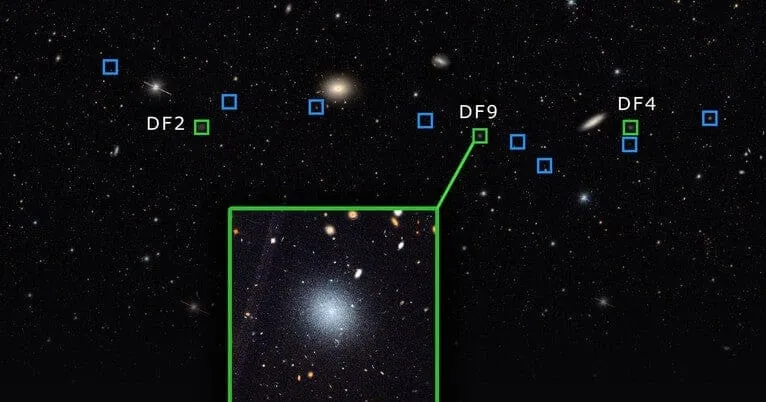
Yale astronomers have identified a third galaxy, NGC-DF9, located 67 million light-years from Earth, that appears to lack dark matter, a theorized invisible material essential to most galaxy formation. This discovery joins previously identified DF2 and DF4, both also found by the same team using the Hubble Space Telescope and the Keck Observatory.
The findings, published in a recent study, challenge the standard model of galaxy formation, which posits that dark matter is a key component in holding galaxies together. The team, led by Yale professor Pieter van Dokkum, used spectroscopic measurements to determine the galaxy's mass and found it consistent with its visible stars alone, with no evidence of dark matter.
NGC-DF9 is part of the NGC 1052 group of galaxies, located in the constellation Cetus. The galaxy's peculiar motion and velocity dispersion were measured to confirm its dark matter deficit. The discovery suggests that dark matter may not be as ubiquitous as previously thought, or that alternative theories of gravity could explain these observations.
The research has significant implications for cosmology, as it provides a natural laboratory to study the role of dark matter in galaxy evolution. Further observations are planned to search for more such galaxies and to test whether they are common or rare in the universe.