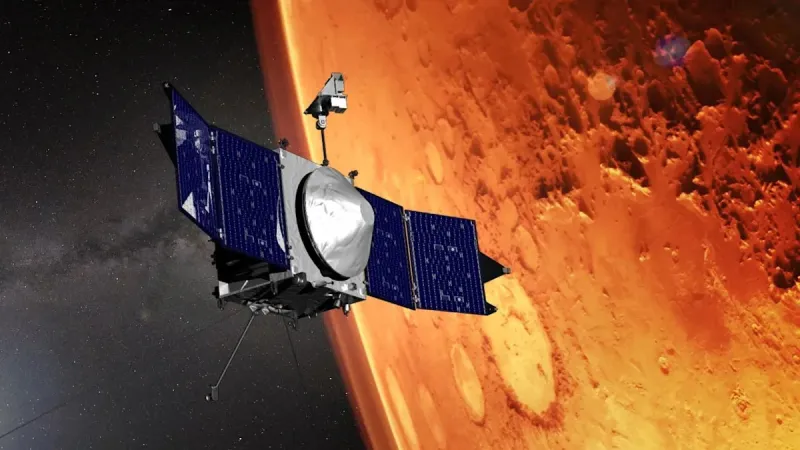
NASA has officially begun decommissioning the MAVEN (Mars Atmosphere and Volatile Evolution) orbiter, following months of unsuccessful recovery efforts. The spacecraft, which arrived at Mars in September 2014, has spent over 11 years studying the planet's upper atmosphere and its interaction with the solar wind.
MAVEN's key findings include determining that the solar wind has stripped away most of Mars' ancient atmosphere, transforming the planet from a warm, wet world to the cold, dry desert it is today. The mission also discovered a new type of aurora on Mars, called 'proton aurora,' and helped scientists understand how dust storms affect the atmosphere.
The decommissioning process involves lowering the orbiter's orbit to ensure it will eventually burn up in Mars' atmosphere, preventing it from becoming space debris. NASA had attempted to recover MAVEN after it entered safe mode in early 2026, but the spacecraft's aging systems could not be fully restored.
MAVEN's legacy includes over 1,000 scientific papers and data that will continue to be analyzed for years. The mission was originally planned for two years but was extended multiple times due to its success.