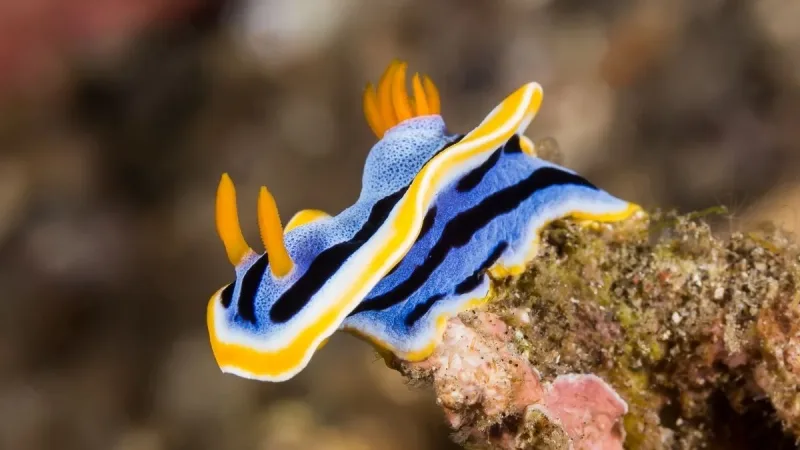
Nudibranchs, often called sea slugs, are renowned for their dazzling colors. Recent scientific research has verified that the brilliant hues of certain species, like the blue-rayed limpet and the sea sapphire copepod, are produced not by pigments but by intricate nanostructures in their skin.
These structures are photonic crystals—nanoscale architectures that manipulate light through interference, reflecting specific, intense colors. This mechanism is similar to the structural color found in butterfly wings and opal gemstones. The crystals act like microscopic 'pixels' to create the animal's overall appearance.
The primary function of this structural color in many marine creatures is likely camouflage or communication in their deep-sea environments. The discovery, made by biologists studying animal optics, provides insights into complex bio-optical engineering in nature.
This research into biological photonic crystals continues to inspire advances in materials science, including the development of new reflective coatings and sensors, by mimicking these efficient natural designs.