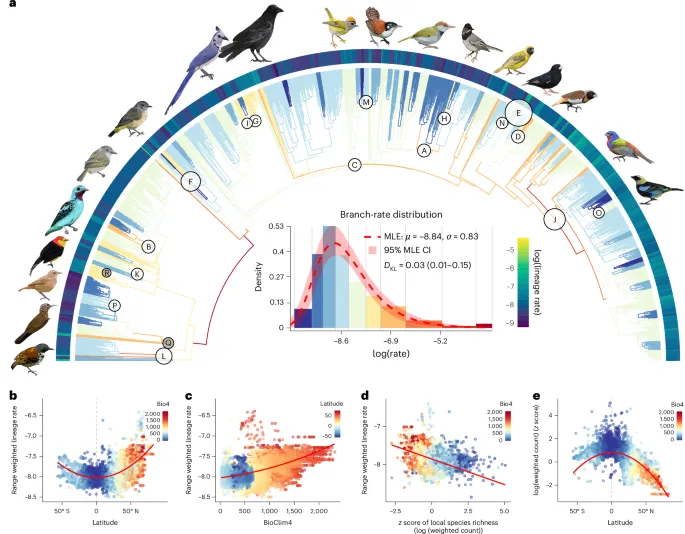
A recent study on passerine birds, published in Science in 2006 by Jablonski, Roy, and Valentine, explored the evolutionary dynamics of the latitudinal diversity gradient. The research indicates that speciation and extinction rates vary across latitudes, with tropical regions showing higher biodiversity but potentially different evolutionary rates.
Further analysis by Weir and Schluter in 2007 examined the latitudinal gradient in recent speciation and extinction rates of birds. Their findings suggest that temperate zones experience faster molecular evolution rates compared to tropical regions, possibly due to environmental factors like climate variability.
The study underscores the complexity of evolutionary processes across different geographic scales, highlighting that passerine body plan evolution is not uniform. These insights help explain global biodiversity patterns and the mechanisms driving species diversification.