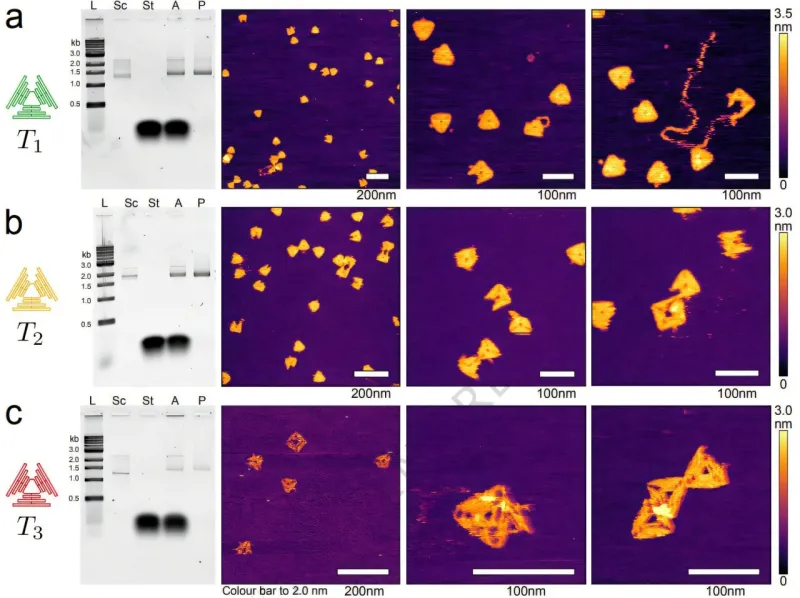
Scientists have created a new computational tool to enhance the reliability of DNA nanostructures built using scaffolded DNA origami. This technique, which folds long DNA strands into precise shapes, holds promise for drug delivery and biosensing. The tool, described in a study published in Nature Communications on June 10, 2026, uses machine learning to predict assembly errors.
Lead researcher Dr. Emily Chen from the University of Cambridge stated, 'Our model can identify problematic sequences before synthesis, saving time and resources.' The team tested the tool on over 100 different nanostructures, achieving a 40% reduction in assembly defects compared to traditional methods.
DNA origami relies on a long 'scaffold' strand and short 'staple' strands that bind to specific locations. Errors often occur when staples bind incorrectly. The new algorithm analyzes staple binding energies to flag potential mismatches. This approach could accelerate the development of nanoscale devices for medical applications.