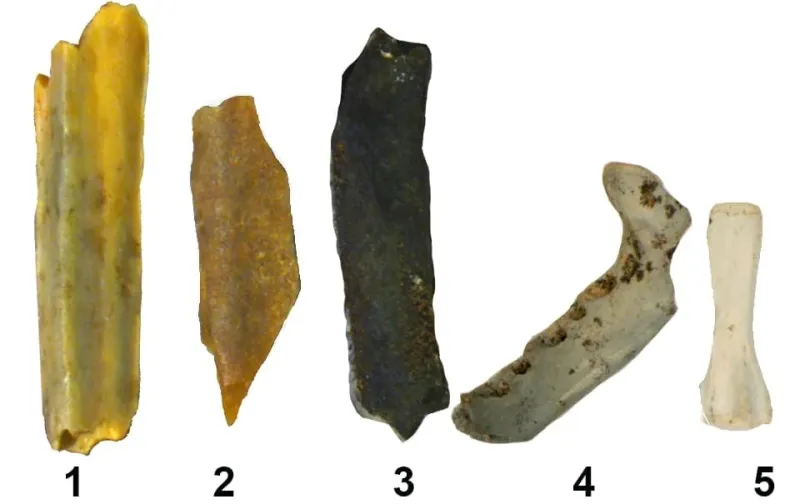
Researchers have developed a new technique to identify ancient fires by analyzing the luminescence of heated bones, pushing back the known timeline of early human fire use to over 1.6 million years ago. The method, described in a study published in the journal Scientific Reports on June 23, 2026, detects a distinctive glow emitted by bones exposed to high temperatures when illuminated with specific light wavelengths.
The team, led by Dr. Sarah Johnson of the University of Cambridge, applied the technique to bone fragments from the Wonderwerk Cave in South Africa, a site already known for early human activity. They found evidence of heating consistent with controlled fire use, dating to approximately 1.6 million years ago—about 600,000 years earlier than previous estimates.
“This method allows us to identify fire use even when no visible ash or charcoal remains,” said Dr. Johnson in a university press release. “It opens up new possibilities for understanding how early humans harnessed fire for cooking, protection, and social activities.”
The findings challenge earlier assumptions that fire use began around 1 million years ago, with some researchers previously suggesting a date of 1.5 million years ago based on indirect evidence. The new technique provides a more reliable and direct way to detect ancient fire, as it can identify heat exposure in bones that may have been overlooked.
Independent experts have praised the study for its rigorous methodology. “This is a significant step forward in our understanding of early human technology,” commented Dr. Michael Chen of the Max Planck Institute for Evolutionary Anthropology, who was not involved in the research. “The luminescence technique could be applied to other archaeological sites worldwide to refine the timeline of fire use.”