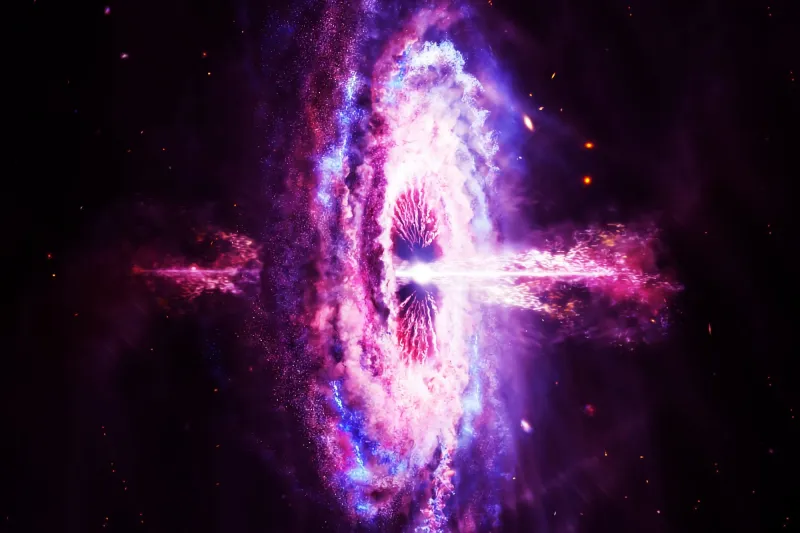
Astronomers have long struggled with a 'sensitivity gap' in gamma-ray observations between 500,000 and 1,000,000 electronvolts (0.5–1 MeV). This energy range is critical for studying gamma-ray bursts (GRBs), the most powerful explosions in the universe, and emissions from massive black holes. Current instruments like Fermi's GBM and Swift's BAT are less sensitive in this band, leaving a blind spot in high-energy astrophysics.
To address this, a team led by researchers at the University of California, Berkeley, and the University of Alabama in Huntsville has proposed the 'Galactic Explorer for Time-domain Astrophysics' (GETA) mission. GETA would use a novel detector design, combining scintillators and solid-state detectors, to achieve 10 times better sensitivity in the 0.5–1 MeV range than existing telescopes. The mission concept was presented at the 2026 American Astronomical Society meeting and is under consideration by NASA for a potential launch in the early 2030s.
If selected, GETA would also monitor the sky for transient events like neutron star mergers and solar flares, providing real-time alerts to ground-based observatories. The mission's cost is estimated at $150 million, with a planned three-year primary mission. 'Closing this gap will let us see the universe in a completely new light,' said Dr. Fiona Harrison, a co-investigator on the project.