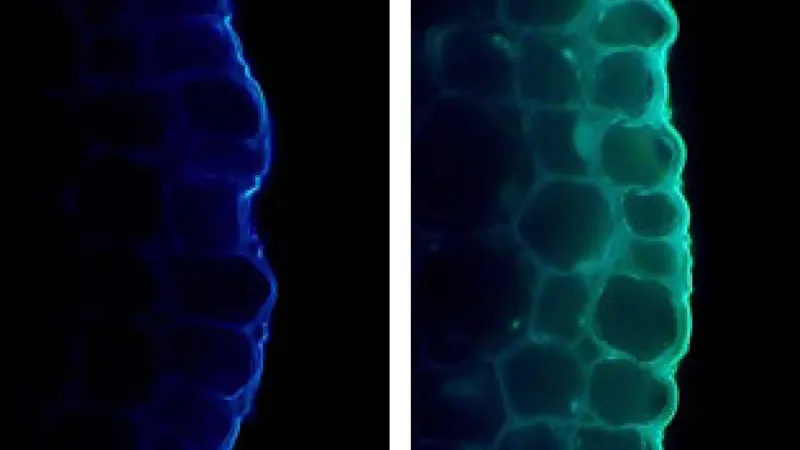
New research from the University of Tokyo has uncovered a dual role for light in plant development. A team led by Professor Kouichi Soga from the Graduate School of Science investigated how light affects the mechanical properties of young pea stems. Their findings, published in the journal Nature Communications, reveal that light strengthens the bond between the stem's outer layer (epidermis) and inner tissues but simultaneously restricts the stem's ability to grow thicker.
The researchers used a specialized micro-mechanical technique to measure the adhesive strength between the epidermal layer and the inner cortical tissues. They discovered that light exposure significantly increases this adhesion, making the stem structure more robust. This strengthening is mediated by specific photoreceptors and the plant hormone auxin.
However, this increased adhesion comes at a cost. The stronger bond physically constrains the expansion of the inner cortical cells. In darkness, these inner cells can expand more freely, leading to thicker stems, even though the epidermal attachment is weaker. The study demonstrates that plants face a fundamental trade-off between mechanical strength and growth potential dictated by their light environment.
This research provides a clearer understanding of photomorphogenesis—how light shapes plant form. The insights could inform agricultural practices and the development of crops optimized for different light conditions, balancing structural integrity with growth yield.