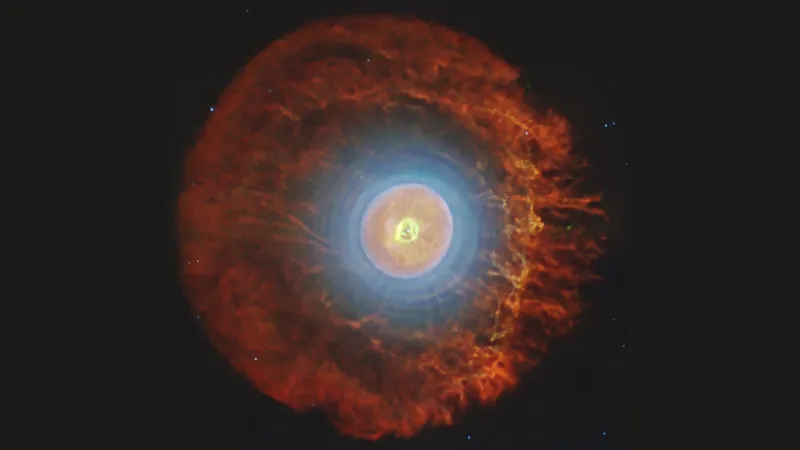
The James Webb Space Telescope (JWST) has captured new imagery of a planetary nebula surrounding a dying star, revealing the presence of complex carbon molecules known as buckyballs (C60). The nebula, designated as NGC 7027, is located approximately 3,000 light-years from Earth in the constellation Cygnus.
In the images, a prominent feature resembling an upside-down question mark is visible, which scientists have identified as a structure of unknown origin. This structure may be related to the ejection of material from the central star during its late evolutionary stages.
Buckyballs, or fullerenes, are spherical molecules composed of 60 carbon atoms arranged in a pattern similar to a soccer ball. Their detection in NGC 7027 provides insights into the chemical processes occurring in the final phases of stellar evolution, as these molecules are thought to form in the carbon-rich environments of dying stars.
The JWST observations, made with its Near-Infrared Camera (NIRCam) and Mid-Infrared Instrument (MIRI), offer a detailed view of the nebula's structure and composition. The data help astronomers understand how complex organic molecules can be synthesized in space and potentially seeded into planetary systems.