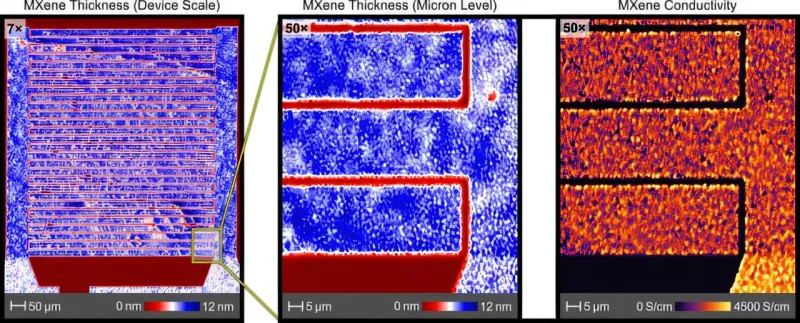
A German–Israeli research team led by Dr. Andreas Furchner has demonstrated how imaging ellipsometry enables non-destructive characterization and quality control of microstructured MXene thin films during device fabrication. The study, published in a peer-reviewed journal, shows that this optical technique can monitor film thickness and optical properties without damaging the sample.
MXenes are a class of two-dimensional transition metal carbides, nitrides, or carbonitrides with high electrical conductivity and tunable surface chemistry. They are promising for applications in energy storage, electromagnetic interference shielding, and sensors. However, their thin-film quality is critical for device performance.
The researchers used imaging ellipsometry to map the spatial uniformity of MXene films over large areas. The method provided real-time feedback during fabrication, allowing for immediate adjustments. The team verified the results with complementary techniques like atomic force microscopy and scanning electron microscopy.
This approach could accelerate the development of MXene-based devices by reducing waste and improving reproducibility. The work was supported by the German Research Foundation and the Israeli Science Foundation.