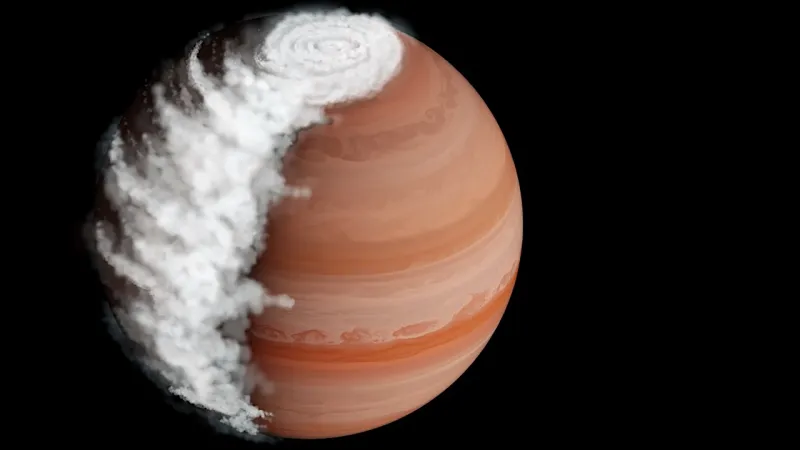
Astronomers have observed that the exoplanet WASP-94A b, a hot Jupiter located about 587 light-years from Earth, experiences daily cloud cycles similar to Earth's weather patterns. The planet orbits its star every 3.95 days and has a temperature of about 1,500 Kelvin (1,227°C).
Using data from NASA's Spitzer Space Telescope and the Hubble Space Telescope, researchers detected variations in the planet's brightness that indicate clouds form on the morning side and dissipate by evening. This is the first time such a regular cloud cycle has been observed on an exoplanet.
The study, published in the journal Nature Astronomy in 2025, was led by Dr. Lisa Kaltenegger of Cornell University. The team used infrared observations to track the planet's thermal emission over multiple orbits.
WASP-94A b was discovered in 2014 by the Wide Angle Search for Planets (WASP) survey. It is a gas giant with a mass about 0.45 times that of Jupiter and a radius about 1.4 times Jupiter's.