Volcanic eruptions can propel lava and other volcanic material to impressive heights, but the exact altitude depends on the type of eruption. According to volcanologist Martin Mangler, speaking on The Conversation's Curious Kids podcast, the height is primarily determined by the amount of gas dissolved in the magma. Magma contains dissolved gases like water vapor and carbon dioxide; as it rises toward the surface, pressure decreases, allowing these gases to expand rapidly and fragment the magma into tephra (rock fragments) and lava droplets.
In explosive eruptions, such as those at Mount St. Helens (1980) or Pinatubo (1991), the gas-driven expansion can send ash and rock tens of kilometers into the atmosphere. For example, the 1991 eruption of Mount Pinatubo in the Philippines produced an eruption column that reached about 35 kilometers (22 miles) high. However, not all eruptions are so violent; effusive eruptions, like those in Hawaii, produce lava fountains that typically reach only tens to a few hundred meters high, as the magma has lower gas content.
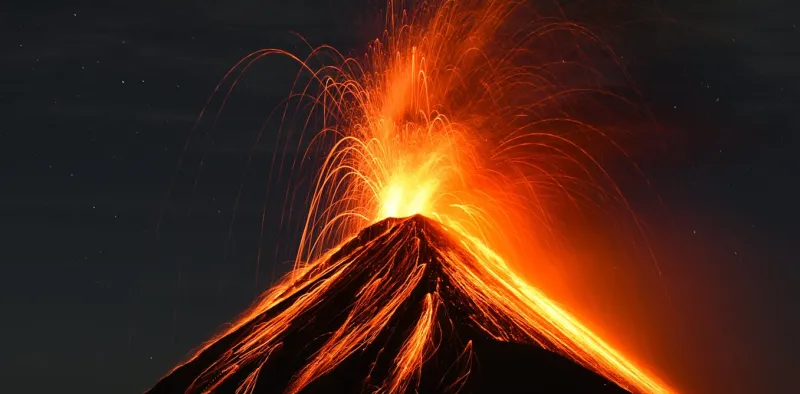
The height of lava fountains in Hawaiian eruptions can vary: Kīlauea's 2018 eruption saw fountains up to 80 meters (260 feet) high, while the 1959 Kīlauea Iki eruption produced fountains reaching 580 meters (1,900 feet). Strombolian eruptions, named after Italy's Stromboli volcano, eject lava bombs and blobs to heights of hundreds of meters, typically 100–300 meters (330–980 feet).
For the most extreme cases, Plinian eruptions—named after the eruption of Mount Vesuvius in 79 AD that destroyed Pompeii—can send material into the stratosphere, exceeding 20 kilometers (12 miles) in height. The 1980 eruption of Mount St. Helens produced a column that reached 24 kilometers (15 miles) high. These heights are measured for the eruption column, which consists of a mixture of gas, ash, and larger particles, rather than purely liquid lava.
In summary, while lava fountains from effusive eruptions are relatively modest, explosive eruptions can launch volcanic material to altitudes rivaling commercial jet flight levels, with the highest columns reaching the stratosphere. The key factor is the gas content of the magma: more gas leads to more explosive eruptions and higher ejection heights.