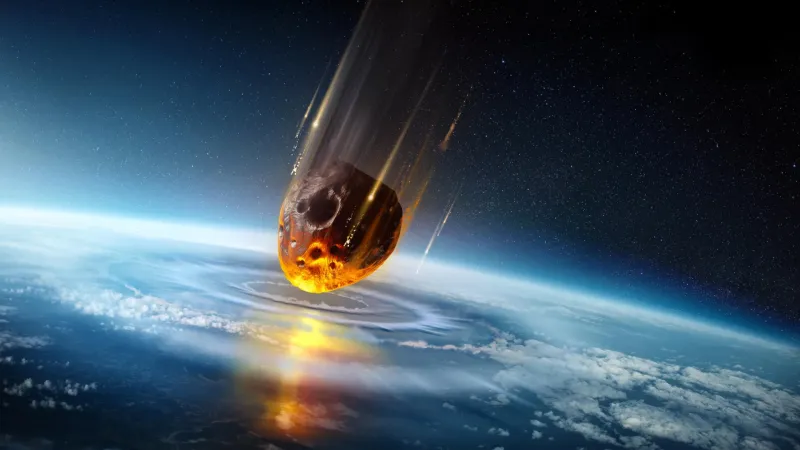
A team of international researchers, including scientists from the University of Cologne, the University of Vienna, and the University of Brussels, has identified the meteorite that struck Earth 66 million years ago, causing the mass extinction of non-avian dinosaurs. By analyzing ruthenium isotopes in rock layers from the Cretaceous-Paleogene boundary, they determined the impactor was a carbonaceous chondrite, a rare type of meteorite originating from the outer solar system, beyond Jupiter.
The study, published in Science on August 15, 2024, examined samples from Denmark, Italy, and Spain. The ruthenium isotope signature matched that of carbonaceous chondrites, ruling out other meteorite types and confirming the object's extraterrestrial origin. The impact created the Chicxulub crater in present-day Mexico, releasing energy equivalent to billions of atomic bombs.
Lead author Dr. Mario Fischer-Gödde of the University of Cologne stated, 'The ruthenium isotopes provide a unique fingerprint that links the impactor to carbonaceous chondrites.' The findings resolve a long-standing debate about the nature of the dinosaur-killing asteroid, which had been hypothesized to be a comet or a different type of meteorite.
This discovery has implications for understanding the frequency of such impacts and the role of carbonaceous chondrites in delivering volatile elements to early Earth. The research was funded by the German Research Foundation and the European Research Council.