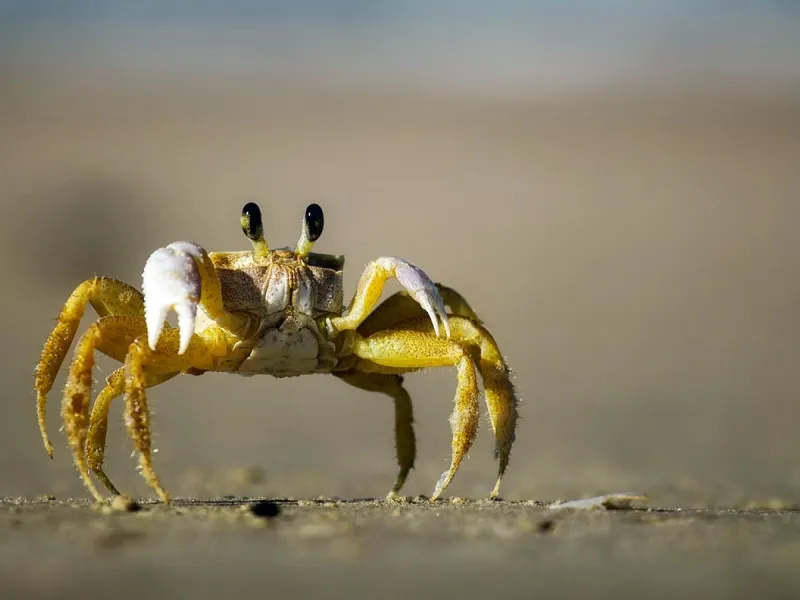
Crabs are known for their distinctive sideways walk, but this trait is not as ancient as one might think. According to fossil evidence and evolutionary biology, crabs began walking sideways approximately 50 million years ago. Their ancestors, which lived during the Jurassic period, moved forward and backward like many other crustaceans.
The shift to sideways locomotion is linked to the evolution of a flattened body shape, which allowed crabs to hide in narrow crevices and under rocks. This adaptation provided better protection from predators. The sideways gait is more efficient for moving along these tight spaces, as the legs are positioned on the sides of the body.
Not all crabs walk sideways. Some species, like the spider crab, can move forward, backward, and sideways. However, the majority of true crabs (Brachyura) have adopted the sideways walk as their primary mode of movement. This behavior is a result of natural selection favoring individuals that could navigate complex environments more effectively.
Research published in journals such as Nature and Proceedings of the Royal Society B has traced the evolutionary history of crab locomotion. The sideways walk is not a universal trait among all crustaceans but is a specialized adaptation in many crab species.