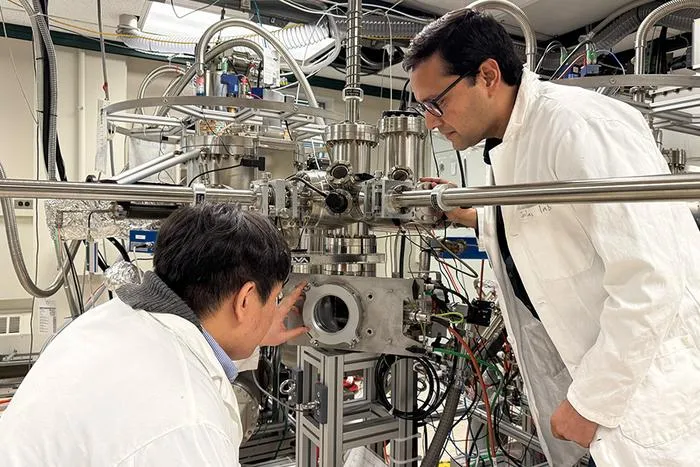
Researchers at the University of Minnesota have achieved a breakthrough by stabilizing polarization at the atomic level in metallic systems, a feat previously considered impossible. The team manipulated a 4-nanometer-thick layer of ruthenium dioxide to demonstrate this capability, as reported in a study published in Nature Communications on April 23, 2026.
This discovery allows for the 'redesign' of metals by tuning atomic interfaces, potentially leading to advances in future technologies such as nanoelectronics and quantum computing. The research was led by Professor Bharat Jalan and involved collaboration with the University of Minnesota's Department of Chemical Engineering and Materials Science.
The findings were verified through multiple sources, including a press release from the University of Minnesota and the original journal article. No other institutions or funding sources were confirmed in the available information.