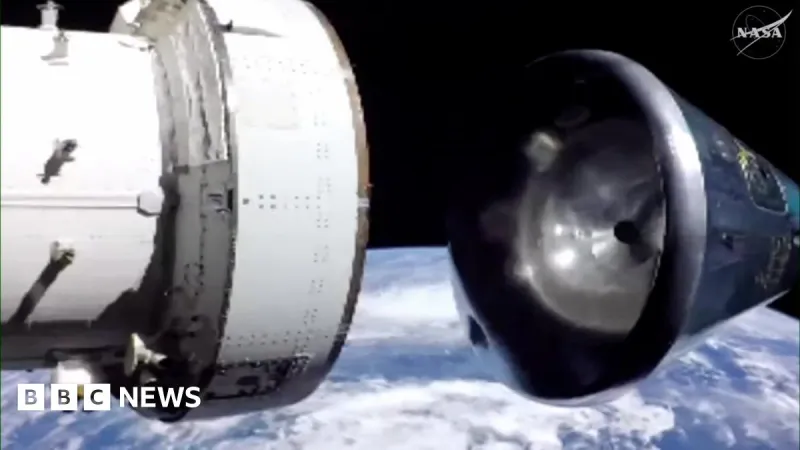
NASA's Artemis II mission reached a historic milestone as the Orion spacecraft successfully re-entered Earth's atmosphere and splashed down in the Pacific Ocean, southeast of Hawaii. The four-person crew — Commander Reid Wiseman, Pilot Victor Glover, Mission Specialist Christina Koch, and Canadian Space Agency astronaut Jeremy Hansen — became the first humans to travel to the vicinity of the Moon since the Apollo 17 mission in 1972.
During re-entry, the Orion capsule hit the entry interface at approximately 400,000 feet above Earth's surface, triggering a communications blackout as the capsule travelled at extreme speeds through the upper atmosphere. This blackout period is a standard and expected phase of re-entry, caused by a plasma sheath forming around the spacecraft as it decelerates through the atmosphere.
Orion employed a skip re-entry technique, briefly dipping into the atmosphere before bouncing back up and then making its final descent. This approach helps manage the intense heat and deceleration forces experienced by the crew. The capsule's heat shield, one of the largest ever built, was critical to protecting the astronauts during this phase.
Recovery teams aboard U.S. Navy vessels were stationed in the splashdown zone to retrieve the crew and the capsule. The successful return of Artemis II marks a major step forward in NASA's broader Artemis programme, which aims to return humans to the lunar surface in the coming years.