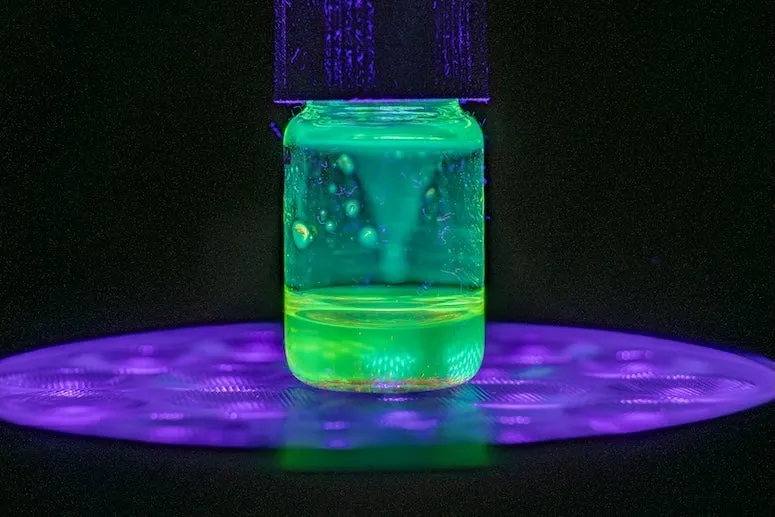
Researchers at Rice University have resolved a long-standing mystery in the behavior of organic light-emitting crystals, shedding new light on why these materials behave differently depending on their physical form. The findings, published in a peer-reviewed journal, could have significant implications for the development of next-generation displays, solar energy devices, and advanced imaging systems.
The study focused on anthracene, a well-studied polycyclic aromatic hydrocarbon that has been used as a model material in organic electronics research for decades. Scientists had long observed that anthracene crystals emit light differently in bulk form compared to thin films or isolated molecules, but the precise mechanism behind this discrepancy had remained elusive.
The Rice team, led by researchers in the university's Department of Chemistry, used advanced spectroscopic techniques to identify how molecular packing and intermolecular interactions within the crystal structure influence the material's photophysical properties. Their work revealed that subtle changes in how molecules are arranged relative to one another can dramatically alter the pathways through which excited electrons release energy as light.
The discovery is particularly relevant for the field of organic light-emitting diodes (OLEDs), where controlling and predicting light emission efficiency is critical. Understanding the fundamental physics of these materials at the molecular level could help engineers design more efficient and durable organic electronic devices. The Rice researchers noted that their findings provide a framework that could be applied broadly across a range of organic crystalline materials used in optoelectronics.