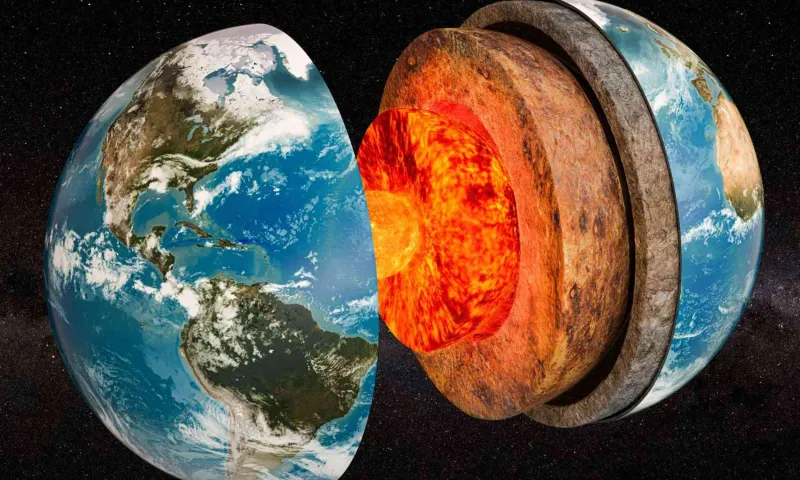
Recent research has revealed that ancient slabs of Earth's tectonic plates, buried up to 1,800 miles (2,900 kilometers) below the surface, are still actively warping the planet's deepest rock layer. This discovery challenges previous assumptions that such subducted material becomes inert over geological time.
Using advanced seismic imaging, scientists from institutions including the University of Colorado Boulder and the California Institute of Technology have identified these remnants in the lower mantle, near the core-mantle boundary. The slabs, some dating back hundreds of millions of years, are causing deformations that influence mantle convection and heat flow.
Dr. Harriet Lau, a geophysicist at the University of Colorado Boulder, stated, 'These ancient slabs are not just passive remnants; they are actively deforming the deep Earth.' The findings were published in the journal Nature Geoscience in April 2026.
The research provides new insights into how tectonic processes shape the planet's interior dynamics, potentially affecting surface phenomena like volcanic activity and earthquake patterns. However, experts caution that more data is needed to fully understand the long-term implications.