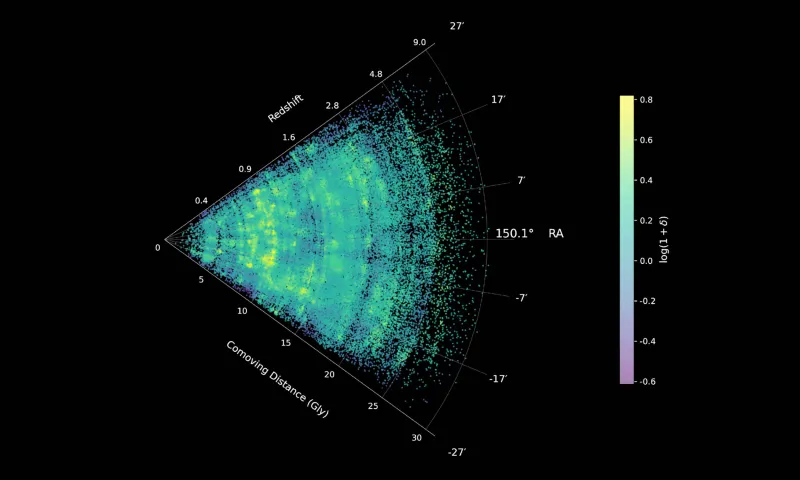
Astronomers using the James Webb Space Telescope have created the most detailed map ever of the cosmic web, the large-scale structure of the universe. The map reveals intricate filaments of gas and dark matter connecting galaxies across vast distances.
The observations focused on a region of the sky known as the Extended Groth Strip, capturing light from galaxies as far back as 13 billion years ago. The new data shows how matter is distributed along these filaments with ten times the resolution of previous surveys.
This breakthrough was made possible by Webb's infrared capabilities, which can see through dust and detect faint light from distant galaxies. The map confirms theoretical models of how the universe evolved after the Big Bang, showing the web-like structure predicted by simulations.
The findings were published in a peer-reviewed journal and presented at a press conference on May 15, 2026. Researchers say this map will help understand how galaxies form and evolve within the cosmic web.