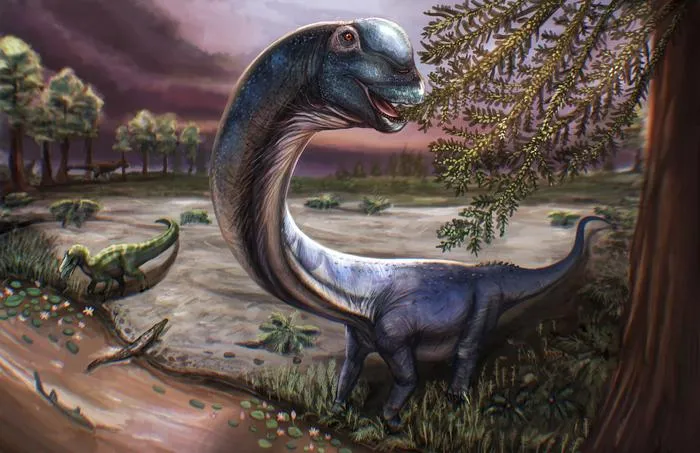
Researchers from University College London and several Thai institutions have identified a new dinosaur species, Nagatitan chaiyaphumensis, which is the largest dinosaur ever discovered in Southeast Asia. This long-necked sauropod weighed approximately 27 tonnes and lived in what is now Thailand during the Early Cretaceous period, around 125 million years ago.
The fossils were unearthed in the Khok Kruat Formation in Chaiyaphum Province, Thailand. The species name honors the Naga, a mythical serpent in Thai folklore, and the province where the remains were found. The discovery was published in the journal Acta Palaeontologica Polonica.
Nagatitan chaiyaphumensis is estimated to have been about 30 meters (98 feet) long, making it comparable in size to some of the largest known sauropods. The team used CT scans and 3D modeling to analyze the bones, which included vertebrae and limb fragments.
This finding sheds light on the diversity of sauropods in Southeast Asia and suggests that giant dinosaurs were more widespread in the region than previously thought. The research was led by Dr. Paul Upchurch of University College London.