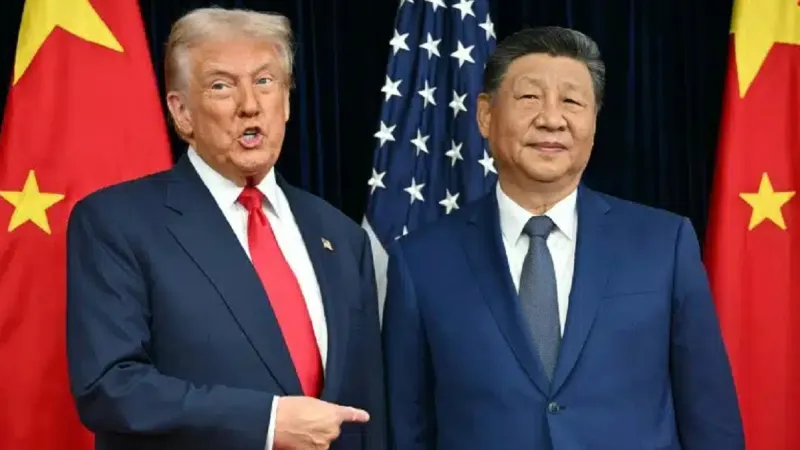
For decades, globalization relied on a simple logic: produce at the lowest cost, fragment value chains, and maximize economic efficiency. This model gradually reduced the importance of borders. However, the US-China rivalry has introduced a new dynamic of 'constrained interdependence,' where economic ties persist but are increasingly shaped by geopolitical tensions.
According to a 2025 report by the McKinsey Global Institute, global trade in goods as a share of GDP has plateaued since 2008, and cross-border data flows have slowed. The US has imposed tariffs on over $350 billion worth of Chinese goods, while China has retaliated with tariffs on US products. The US CHIPS and Science Act of 2022 allocated $52.7 billion to boost domestic semiconductor production, reducing reliance on Asian suppliers.
Supply chains are diversifying. The World Bank reported in 2025 that foreign direct investment flows to Southeast Asia increased by 15% year-on-year, while Mexico became the top trading partner of the US in 2024, surpassing China. The IMF noted in its April 2026 World Economic Outlook that global GDP growth is projected at 3.2% for 2026, with risks tilted to the downside due to trade fragmentation.
Technology decoupling is particularly pronounced. The US has restricted exports of advanced semiconductors and chip-making equipment to China. In response, China has invested heavily in domestic chip production, with its semiconductor self-sufficiency rate rising from 15% in 2020 to an estimated 25% in 2025, according to the Semiconductor Industry Association. The EU has also launched its own Chips Act, aiming to double its global market share to 20% by 2030.
The future of globalization will likely involve 'friend-shoring' and 'near-shoring,' as countries prioritize supply chain resilience over pure efficiency. The World Trade Organization has warned that further fragmentation could reduce global GDP by up to 5% in the long term. The challenge for policymakers is to manage this transition without triggering a full-scale economic war.