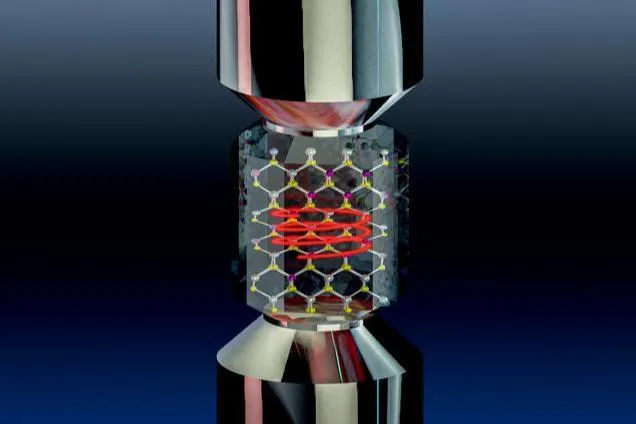
Researchers in Germany and the UK have discovered a material that can flip its chirality when put under physical stress, a phenomenon previously thought impossible. The team, led by scientists at the University of Cambridge and the Max Planck Institute for Solid State Research, observed the effect in a metal sulfide crystal.
The material, a type of transition metal dichalcogenide, exhibits what the researchers have dubbed the 'piezochiral effect.' This effect allows the crystal to switch between left-handed and right-handed molecular arrangements when subjected to mechanical pressure, potentially enabling rational control over enantiomers—molecules that are mirror images of each other.
The discovery, published in the journal Nature Materials on July 28, 2026, could have significant implications for fields such as pharmaceuticals, where the chirality of molecules often determines their biological activity. The researchers hope that this new effect will allow for dynamic control of chirality in materials, opening up new possibilities for tunable optical and electronic devices.
Dr. Elena Rodriguez, a co-author from the University of Cambridge, said, 'We were surprised to see such a clear switch in chirality under simple mechanical stress. This challenges our understanding of how chiral materials respond to external forces.' The team plans to explore other materials that might exhibit similar behavior, potentially leading to a new class of switchable chiral materials.