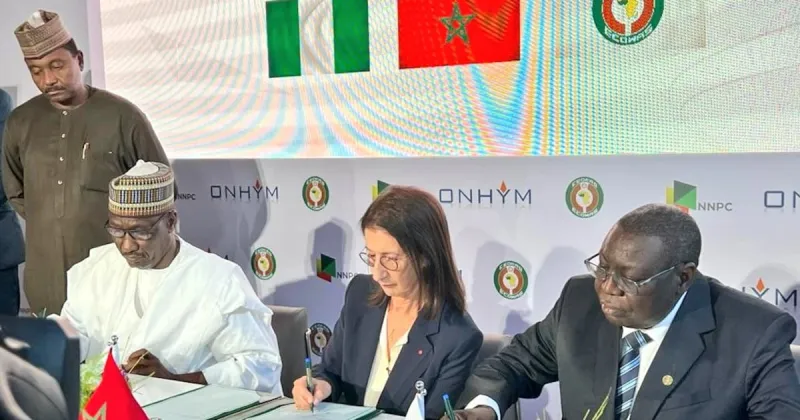
Nigeria and Morocco have formally signed an intergovernmental agreement to advance the Nigeria-Morocco Gas Pipeline (NMGP) project. The signing ceremony took place in 2026, marking a critical step for the long-planned infrastructure initiative. The agreement was signed by Nigerian Minister of State for Petroleum Resources (Gas) Ekperikpe Ekpo and Moroccan Minister of Energy Transition and Sustainable Development Leila Benali.
The NMGP is a proposed 5,600-kilometer offshore pipeline that would transport natural gas from Nigeria along the West African coast to Morocco, with potential extensions to Europe. The project, first announced in 2016, is intended to foster regional economic integration and provide a new export route for Nigerian gas. It is being developed by the national oil companies of both countries, Nigeria's NNPC Limited and Morocco's ONHYM.
While the agreement establishes a legal framework for cooperation, significant hurdles remain. The project's final investment decision (FID) has not yet been reached, and construction timelines and total costs, previously estimated in the tens of billions of dollars, are still under discussion. The pipeline's route would pass through the territorial waters of over a dozen West African nations, requiring further complex bilateral agreements.
The development comes amid a global push for energy security and transition. Proponents argue the pipeline could supply gas to boost industrialization in West Africa and supply European markets. Critics point to the lengthy timeline, geopolitical complexities, and financial challenges facing such mega-projects, especially as global energy markets evolve.