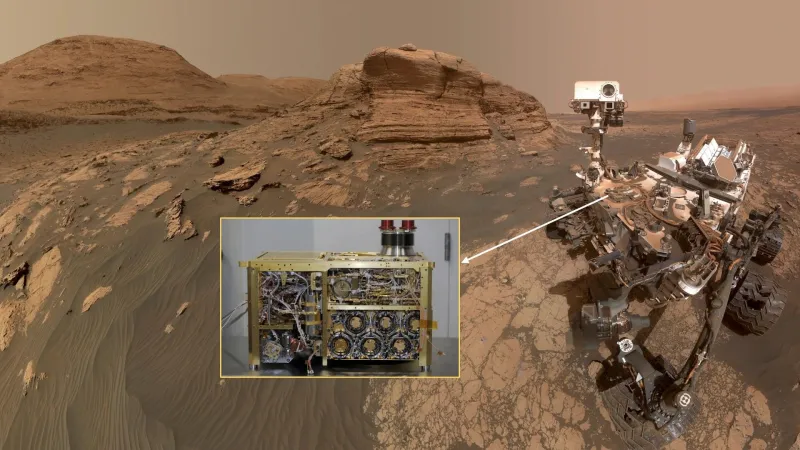
NASA's Curiosity rover has discovered a diverse array of organic molecules in ancient Martian rocks, according to data from its onboard laboratory. The findings, detailed in a study published in the journal Nature, include thiophenes, benzene, toluene, and small carbon chains like propane or butene. These compounds are considered fundamental building blocks for life as we know it.
The molecules were found within the Gale Crater, a site believed to have held a lake billions of years ago. Scientists used Curiosity's Sample Analysis at Mars (SAM) instrument, which heats rock samples to release gases for analysis. This marks a significant application of a new experiment using SAM's wet chemistry lab, designed to extract a wider range of organic compounds.
Researchers emphasize that while these molecules are essential for life, their presence is not direct evidence of past or present life on Mars. They could have been formed through non-biological geological processes. The discovery, however, confirms that ancient Martian environments preserved these materials and suggests the planet's past habitability.
The study helps identify which molecules are present and informs the search for potential biosignatures. NASA's Perseverance rover, currently exploring Jezero Crater, is collecting samples for a future return mission to Earth, where more sophisticated analysis could provide further clues about Mars's organic chemistry and its potential for hosting life.