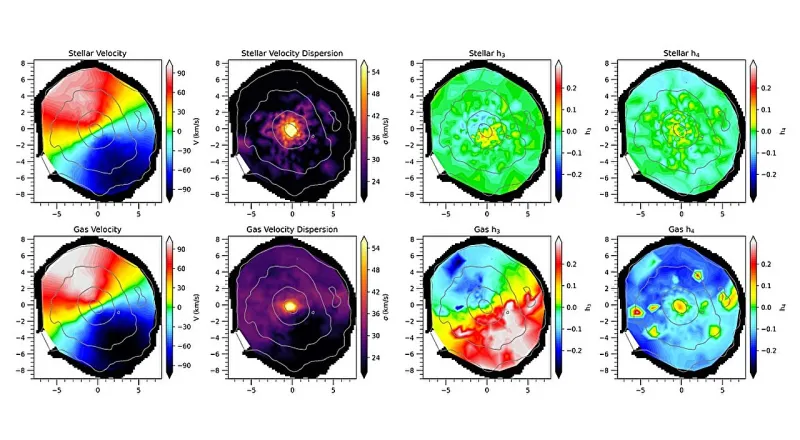
Astronomers have used the Multi-Unit Spectroscopic Explorer (MUSE) on the Very Large Telescope (VLT) to conduct deep spectroscopic observations of the peculiar spiral galaxy W2246f. The study, published on May 27, 2026, reveals an old core and ongoing star formation across the galaxy's disk.
The observations show that W2246f has a massive, old stellar core, indicating that the galaxy formed early in the universe's history. However, the disk of the galaxy is still actively forming new stars, suggesting a complex evolutionary history.
This research provides new insights into the formation and evolution of spiral galaxies, highlighting the coexistence of ancient and young stellar populations. The findings were made possible by the high sensitivity and spatial resolution of MUSE, which allows detailed mapping of galaxy properties.