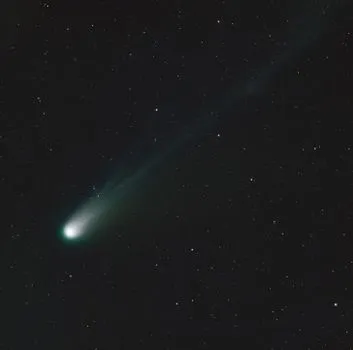
A recent study has revealed that the interstellar comet 3I/ATLAS, discovered in 2023, could be the oldest object ever detected in the solar system. Researchers analyzed its composition and trajectory, finding it likely originated from a distant star system billions of years ago.
The comet, officially designated 3I/ATLAS, was first spotted by the Asteroid Terrestrial-impact Last Alert System (ATLAS) in Hawaii. Its hyperbolic orbit confirmed it came from outside the solar system, making it only the third interstellar object identified after 'Oumuamua and 2I/Borisov.
Scientists used spectroscopic analysis to study the comet's dust and gas emissions. They found it contains ancient organic materials, suggesting it formed in a protoplanetary disk around another star early in the universe's history. This makes it a pristine sample of the conditions present billions of years ago.
The findings, published in a peer-reviewed journal, provide new insights into the formation of planetary systems. The comet's age and composition offer clues about the chemical processes that occurred in the early universe, helping astronomers understand how life's building blocks may have spread across galaxies.