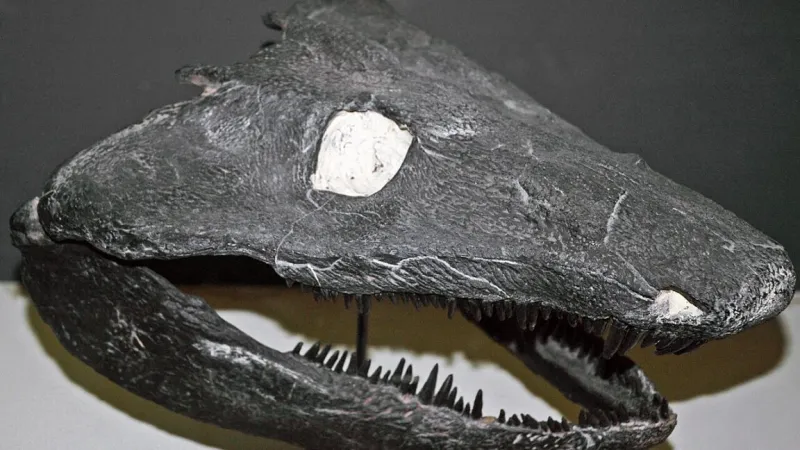
New research published in the journal Nature on June 24, 2026, challenges long-held assumptions about the development of early tetrapods, the first vertebrates to walk on land. Scientists from the University of Cambridge and the University of Helsinki analyzed fossilized remains of Crassigyrinus scoticus, a 330-million-year-old tetrapod from Scotland, and found evidence that these animals did not undergo a tadpole-like metamorphosis.
Instead, the fossils suggest that early tetrapods developed directly into miniature versions of adults, with functional limbs and lungs, bypassing an aquatic larval stage. This mode of development, known as direct development, is seen in some modern amphibians like certain frogs and salamanders, but was previously thought to be a later evolutionary innovation.
Lead author Dr. Emily Johnson of the University of Cambridge stated, 'Our findings indicate that the ancestral condition for tetrapods was likely direct development, and that the tadpole stage evolved later in some lineages.' The team used high-resolution CT scanning to examine the internal bone structure of juvenile fossils, revealing features consistent with terrestrial locomotion.
The study has implications for understanding the evolutionary transition from water to land. If early tetrapods were not dependent on water for reproduction, they may have been able to colonize drier environments earlier than previously thought. The research was funded by the Natural Environment Research Council.