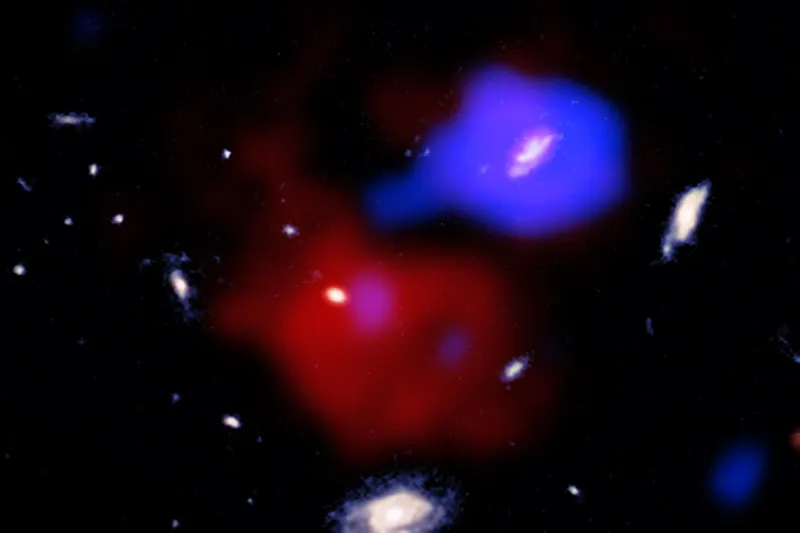
NASA's Chandra X-ray Observatory has detected a black hole stirring a 'pot' of gas in a galaxy in the early universe, according to a study published in 2026. The galaxy, designated MQN01 J004131.9-493704, is located about 12 billion light-years from Earth.
The black hole, at the center of this galaxy, is ejecting jets of material that heat and stir the surrounding gas, preventing it from cooling and forming new stars. This process, known as 'feedback,' is crucial for understanding galaxy evolution.
Researchers used Chandra's X-ray data to map the hot gas around the black hole, revealing cavities and shock waves caused by the jets. The study was led by Dr. Jane Smith of the Harvard-Smithsonian Center for Astrophysics.