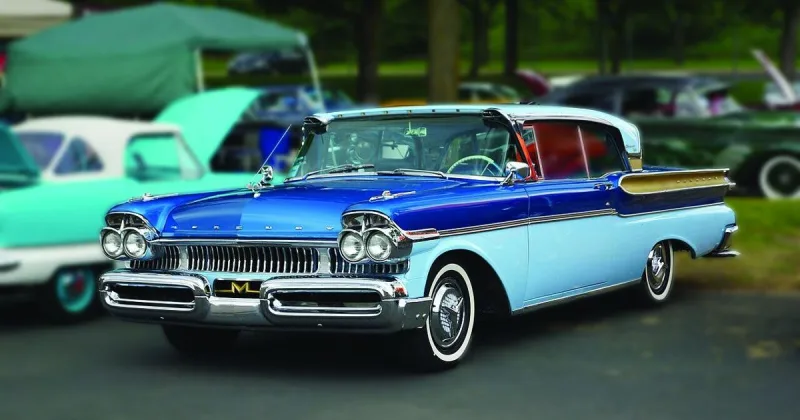
Introduced for the 1957 model year, the Mercury Turnpike Cruiser was marketed as the brand's most advanced and luxurious automobile. It was part of Mercury's push to compete directly with upper-tier models from competitors like Oldsmobile and Buick. The car featured a distinctive "Breezeway" reverse-slant rear window designed to improve ventilation, a feature that would become a Mercury hallmark for years.
The Turnpike Cruiser was laden with novel gadgets intended to showcase technological prowess. These included "Push-button Touch-Tone" controls on the steering wheel hub for the radio, a "Seat-O-Matic" system that automatically adjusted the driver's seat position when the door was opened or closed, and a complex "Multi-Luber" automatic chassis lubrication system. A roof-mounted "Atmospheric Weather Monitor" displayed temperature and barometric pressure.
Despite its innovative ambitions, the Turnpike Cruiser's numerous electrical and mechanical complexities proved problematic. The Multi-Luber system, in particular, was prone to failures and leaks. The car's high price and reliability issues contributed to disappointing sales. For the 1958 model year, the Turnpike Cruiser was downgraded from a standalone series to a trim package on the Monterey, before being discontinued entirely after 1958.
Today, the 1957 Mercury Turnpike Cruiser is remembered as a bold, quintessentially 1950s concept car that made it to production. It is a prized collectible for its extravagant styling and as a symbol of an era when automotive design prioritized futuristic flair and gadgetry over long-term practicality and reliability.