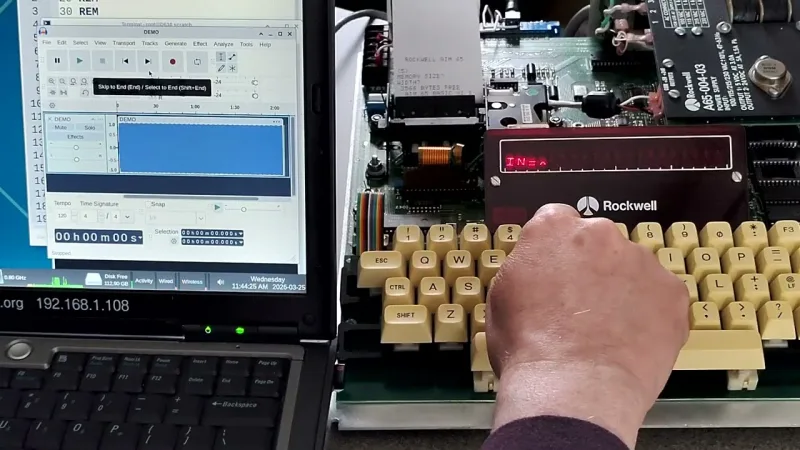
A hobbyist has demonstrated a novel method for loading programs into a vintage Rockwell AIM 65 microcomputer by using an audio file instead of manual typing. The Rockwell AIM 65, introduced in the late 1970s, is a single-board computer known for its integrated keyboard, 20-character alphanumeric LED display, and a built-in thermal printer, used primarily for development and educational purposes.
The project, documented by hacker Casey Bralla, addresses the tedious process of manually entering machine code via the keyboard, which was a common method for bootstrapping such early systems. By converting a program's binary data into audio tones saved in a standard .WAV file and playing it into the computer's cassette interface, the system can load code significantly faster and more reliably than manual entry.
This technique leverages the original hardware's Kansas City Standard (KCS) data cassette interface, a common storage method for computers of that era. The adaptation required understanding the specific timing and waveform requirements of the KCS protocol to generate a compatible audio signal from a modern computer or smartphone.
The successful implementation provides a practical preservation tool for enthusiasts and historians working with vintage computing hardware, offering a more efficient way to load software and demos without relying on rare or degraded original storage media. It highlights ongoing community efforts to maintain and interface with historical technology using contemporary methods.