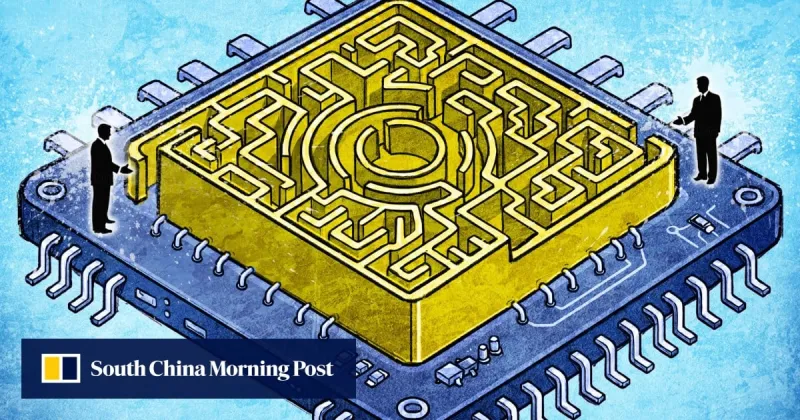
As of May 12, 2026, the United States and China remain locked in a technological competition, with China's rapid advances in artificial intelligence (AI) raising questions about the effectiveness of US chip export controls. The Biden administration imposed restrictions on advanced semiconductor exports to China in 2022 and 2023, aiming to slow Beijing's military AI capabilities. However, Chinese companies like Huawei have developed alternative AI chips, such as the Ascend 910B, and DeepSeek has released AI models that rival US systems, according to reports from the Center for Security and Emerging Technology (CSET) and other analysts.
President Donald Trump, who took office in January 2025, faces a stark choice: escalate controls further or relax them to ease tensions. In April 2026, the Trump administration considered expanding restrictions to include more AI-related software and equipment, but no final decision has been announced as of May 12, 2026. A report from the Congressional Research Service in March 2026 noted that China's semiconductor self-sufficiency rate reached 23% in 2025, up from 16% in 2020, indicating progress despite US curbs.
Experts are divided on the impact of controls. A study by the Peterson Institute for International Economics in February 2026 argued that export controls have slowed China's AI development but not stopped it, while a report from the Information Technology and Innovation Foundation in April 2026 suggested that further restrictions could harm US tech companies' revenues without significantly hindering China. The Chinese government has invested heavily in domestic chip production, with the National Integrated Circuit Industry Investment Fund (Big Fund) allocating $47 billion in 2025 for semiconductor R&D.
The outcome of Trump's decision could reshape global tech supply chains. If controls are relaxed, US companies like Nvidia and AMD could regain access to the Chinese market, which accounted for 30% of global semiconductor sales in 2025, according to the Semiconductor Industry Association. If escalated, China may accelerate its push for self-reliance, potentially leading to a fragmented global AI ecosystem. As of May 2026, no official policy change has been announced, and the debate continues in Washington and Beijing.