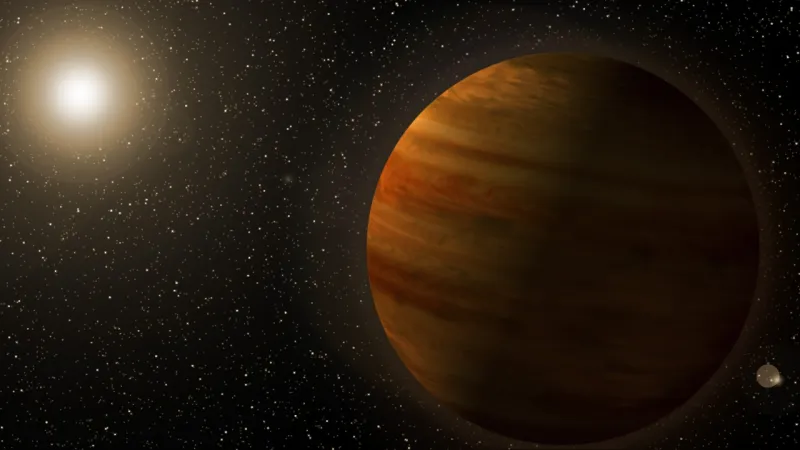
For the first time, NASA's Transiting Exoplanet Survey Satellite (TESS) has identified a planet by observing the gravitational warping of spacetime caused by the planet and its star. This method, known as microlensing, was used to discover a world about the size of Earth or Mars orbiting a star roughly 10,000 light-years away.
The discovery was announced on July 2, 2026, by a team led by researchers from the University of California, Berkeley. The planet, designated TESS-1820b, was detected when the light from a background star was magnified by the gravity of the foreground planetary system, an effect predicted by Einstein's general theory of relativity.
This marks the first time TESS has found a planet using microlensing, which is typically used by ground-based surveys. The finding demonstrates TESS's ability to detect planets that do not transit their host stars, expanding its exoplanet-hunting capabilities.
The planet's exact mass and orbit are still being determined, but it is likely a rocky world in a wide orbit around its dim red dwarf star. The discovery was confirmed using follow-up observations from the Keck Observatory in Hawaii.