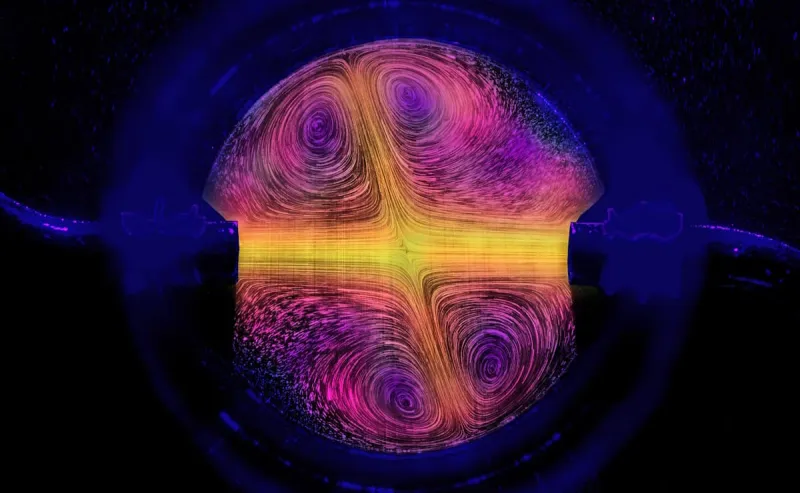
New experiments have provided insights into the 'reverse sprinkler' problem, a physics puzzle popularized by Richard Feynman. Researchers at the University of California, Santa Barbara, used modified rotary sprinklers to study the phenomenon, according to a study published in Physical Review Letters on July 17, 2026.
The team, led by physicist Leif Ristroph, found that when a sprinkler is placed underwater and water is sucked in instead of sprayed out, it rotates in the opposite direction. The motion is driven by the angular momentum induced by the water flow, not by the jet forces as previously thought.
Ristroph explained that the reverse sprinkler's rotation is a result of the water's angular momentum being transferred to the sprinkler arms. The experiments involved high-speed cameras and precise measurements to track the motion, confirming Feynman's original intuition that the reverse sprinkler would rotate, but with a different mechanism.
The findings resolve a long-standing debate in fluid dynamics and have implications for understanding propulsion systems and fluid behavior. The study was funded by the National Science Foundation.