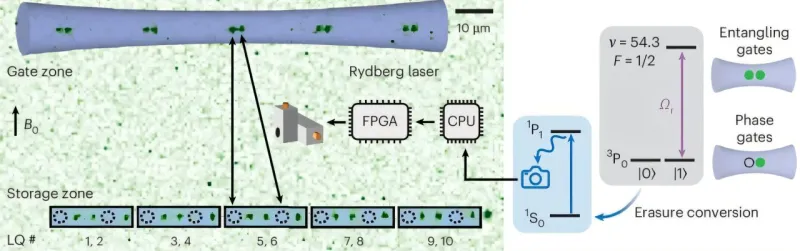
Researchers have developed a quantum circuit based on neutral atoms that can identify and correct errors, a critical advancement for building reliable quantum computers. The work, published in Nature on July 15, 2026, demonstrates a surface code implementation using arrays of neutral atoms held by optical tweezers.
The team, led by scientists at the University of Wisconsin-Madison and Harvard University, achieved a logical error rate of 0.003 per cycle, outperforming physical qubit error rates. This is the first time neutral atoms have been used to realize a distance-3 surface code, capable of correcting any single-qubit error.
Neutral atom qubits are promising because they can be scaled to large arrays and have long coherence times. The experiment used 49 qubits arranged in a 7x7 grid, with 25 data qubits and 24 ancilla qubits for syndrome measurement. The system achieved a 99.5% fidelity for two-qubit gates.
This breakthrough brings fault-tolerant quantum computing closer, with potential applications in cryptography, drug discovery, and materials science. The researchers plan to scale the system to larger codes and improve gate fidelities further.