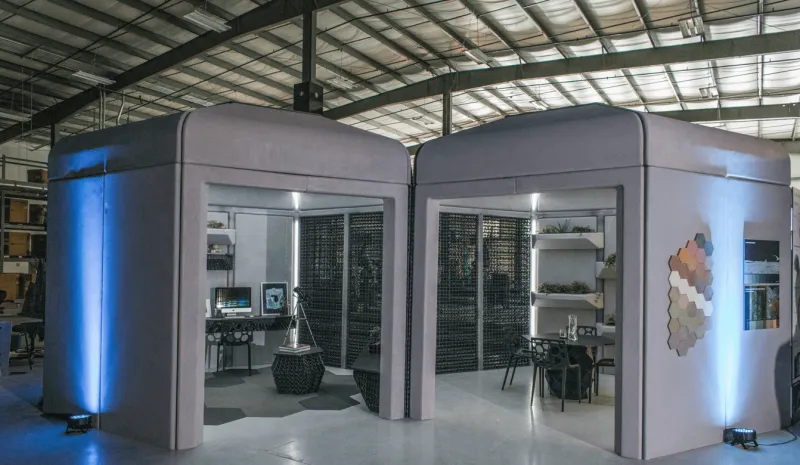
An innovative 3D printing process, originally developed to support NASA's vision for a lunar habitat, is now being applied to construction on Earth, offering new possibilities for sustainable and efficient building design. The technology, created by Branch Technology Inc. of Chattanooga, Tennessee, uses a unique method that builds structures in a cellular, open-web pattern rather than traditional layer-by-layer deposition.
According to NASA's Spinoff publication, the company's 'Freeform 3D Printing Platform' was developed with support from NASA's Marshall Space Flight Center through the Small Business Innovation Research (SBIR) program. The technology allows for the creation of complex, lightweight structures that use less material while maintaining strength, making it ideal for both space habitats and terrestrial construction.
Branch Technology has used this method to construct several buildings, including the 'Branch Studio' in Chattanooga and the 'Casa de la Luz' in Mexico. The process reduces waste and energy consumption compared to conventional construction, and the open-web design allows for integration of insulation and other building systems. The company reports that the technology can reduce material usage by up to 50% compared to traditional methods.
The NASA Spinoff article, published in 2025, highlights how the technology is being commercialized for architectural applications, enabling curved, organic shapes that are difficult to achieve with standard construction techniques. This represents a successful transfer of space technology to address challenges in the building industry.