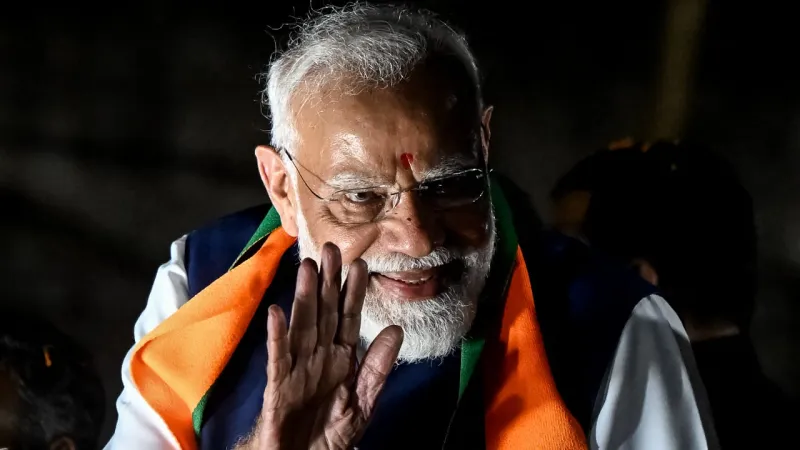
Prime Minister Narendra Modi is set to match Jawaharlal Nehru's record as India's longest-serving continuously elected prime minister on June 10, 2026. Modi took office on May 26, 2014, and will have served 12 years and 15 days by that date, equaling Nehru's first term from 1947 to 1959. Nehru served a total of 16 years and 286 days as prime minister, but his tenure included a break in 1962 during the Sino-Indian war, making Modi's continuous elected streak notable.
Under Modi's leadership, India's economy has seen significant changes. According to World Bank data, India's GDP grew from $2.04 trillion in 2014 to an estimated $3.7 trillion in 2025, making it the fifth-largest economy globally. The IMF projects India's GDP to reach $4.1 trillion by 2026. Inflation, as measured by the Consumer Price Index, averaged around 4.5% in 2025, down from 9.5% in 2014, though food price volatility remains a concern.
Key economic reforms under Modi include the Goods and Services Tax (GST) implemented in 2017, the Insolvency and Bankruptcy Code (IBC) in 2016, and the corporate tax rate cut in 2019. The unemployment rate, as per the Centre for Monitoring Indian Economy (CMIE), fluctuated between 6% and 8% in recent years, with youth unemployment remaining high at around 10% in 2025. Foreign direct investment (FDI) inflows rose from $45 billion in 2014-15 to $83 billion in 2024-25, according to the Department for Promotion of Industry and Internal Trade.
Critics point to challenges such as income inequality, with the Oxfam India report noting that the top 10% hold 77% of national wealth in 2025. Agricultural growth has been uneven, averaging 3% annually, while the manufacturing sector's share of GDP stagnated at around 17%. The Modi government's flagship 'Make in India' initiative has seen mixed results, with electronics manufacturing growing but overall targets unmet.
As Modi approaches this milestone, comparisons with Nehru's era highlight different economic contexts. Nehru's focus on heavy industry and state-led planning contrasts with Modi's emphasis on digitalization, infrastructure, and private sector growth. The milestone is largely symbolic, as Modi's current term ends in 2029, and he could surpass Nehru's total tenure if re-elected.