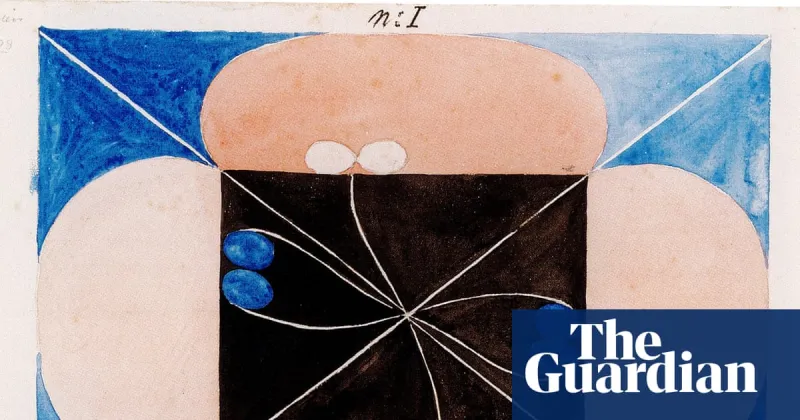
Swedish painter Hilma af Klint (1862–1944) is now widely regarded as one of the earliest pioneers of abstract art, having created large-scale non-representational works as early as 1906 — years before Wassily Kandinsky, Piet Mondrian, and Kazimir Malevich produced the paintings for which they became famous. Yet for decades, af Klint was almost entirely absent from the official history of the movement, a gap that a new exhibition aims to address.
Af Klint kept much of her most ambitious work hidden during her lifetime, reportedly believing that the world was not yet ready to understand it. She stipulated in her will that her major series, The Paintings for the Temple — a cycle of 193 works — should not be shown publicly until at least 20 years after her death. Her nephew, who inherited the work, kept it largely out of public view for even longer. It was not until the 1980s that her paintings began to receive serious international attention.
The exhibition draws attention to the broader pattern of women artists being written out of modernist art history. Despite producing groundbreaking abstract work, af Klint was omitted from landmark surveys of abstraction throughout the 20th century. Scholars and curators have in recent years worked to correct this record, and major retrospectives — including a celebrated show at the Guggenheim Museum in New York in 2018–2019 — have introduced her work to millions of new viewers.
Af Klint's paintings were deeply influenced by spiritualism, theosophy, and anthroposophy, and she was a member of a group of women called 'The Five' who conducted séances and believed they received guidance from higher spiritual beings. This mystical dimension of her work was long used to dismiss her as an outsider rather than a serious modernist, a framing that contemporary critics and historians have challenged. Today, her legacy is considered central to any honest account of how abstract art emerged in the early 20th century.