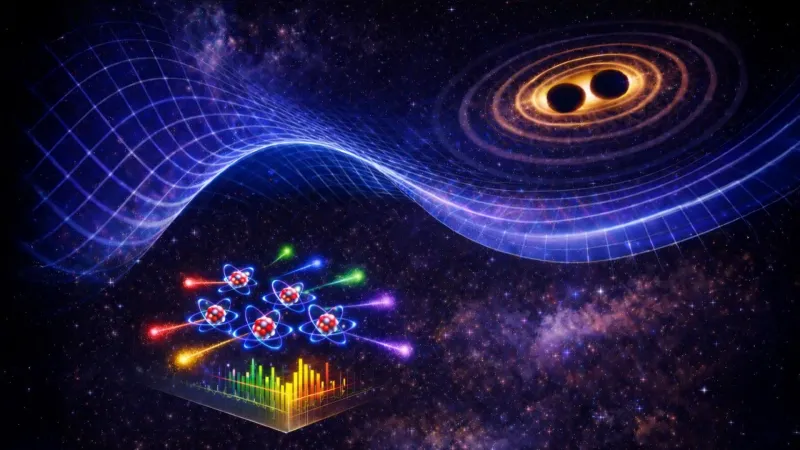
A new theoretical proposal suggests that gravitational waves — ripples in the fabric of spacetime — may leave detectable imprints in one of the most fundamental processes in quantum physics: the spontaneous emission of light by atoms. When an atom absorbs energy, it quickly returns to a lower energy state by releasing a photon at a specific frequency, a process governed by the atom's interaction with the quantum electromagnetic field, known as the quantum vacuum.
Physicists have now proposed that a background of gravitational waves, particularly those thought to have originated in the early universe, could subtly alter this quantum vacuum. Because spontaneous emission rates depend on the properties of the electromagnetic vacuum, any distortion caused by gravitational waves could, in principle, shift the frequency or timing of the light atoms emit — creating a measurable signal hidden within atomic spectra.
This approach is notable because it would offer a completely new and independent method of detecting gravitational waves, distinct from existing observatories such as LIGO, Virgo, and the planned space-based LISA mission. While those instruments detect gravitational waves by measuring tiny changes in the distance between mirrors, this atomic approach would instead look for quantum-level changes in how atoms radiate light.
The proposal remains theoretical, and researchers acknowledge that the predicted effects would be extraordinarily small, posing significant experimental challenges. However, advances in atomic clocks and precision spectroscopy — which can now measure atomic transition frequencies with extraordinary accuracy — may eventually make such detections feasible. If confirmed, the method could open a new window onto the gravitational wave background left over from the Big Bang, providing fresh insights into the earliest moments of the universe.