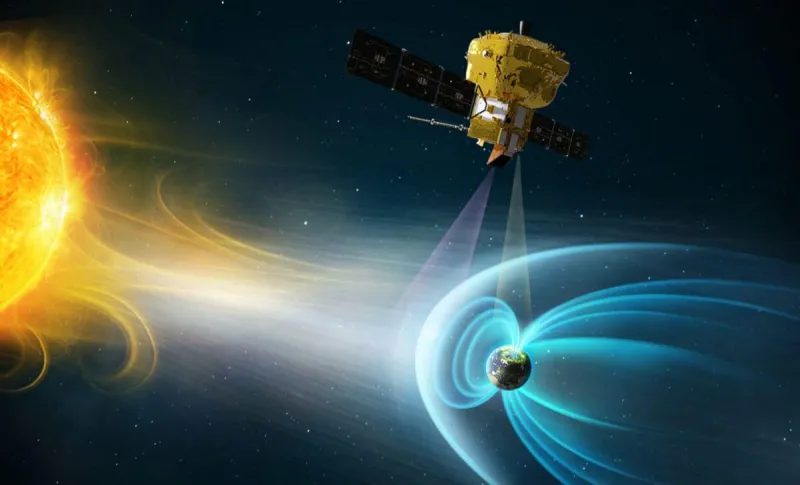
The Solar wind Magnetosphere Ionosphere Link Explorer (SMILE) is a joint mission between the European Space Agency (ESA) and the Chinese Academy of Sciences (CAS). The spacecraft is designed to study the interaction between the solar wind and Earth's magnetosphere, particularly during solar storms.
SMILE will be placed in a highly elliptical orbit, reaching altitudes of up to 121,000 kilometers (about 75,000 miles). This orbit allows it to observe the magnetosphere for extended periods. The mission aims to capture the first-ever X-ray images of the magnetosphere, providing new insights into how solar storms affect our planet's magnetic field.
The spacecraft carries four main instruments: the Soft X-ray Imager (SXI), the Ultraviolet Imager (UVI), the Light Ion Analyser (LIA), and the Magnetometer (MAG). These instruments will work together to monitor the magnetosphere's response to solar wind variations.
As of May 19, 2026, the SMILE mission is scheduled for launch on a Chinese Long March rocket from the Xichang Satellite Launch Center. The launch date has been confirmed for May 2026, though exact timing may be adjusted based on weather and technical conditions.