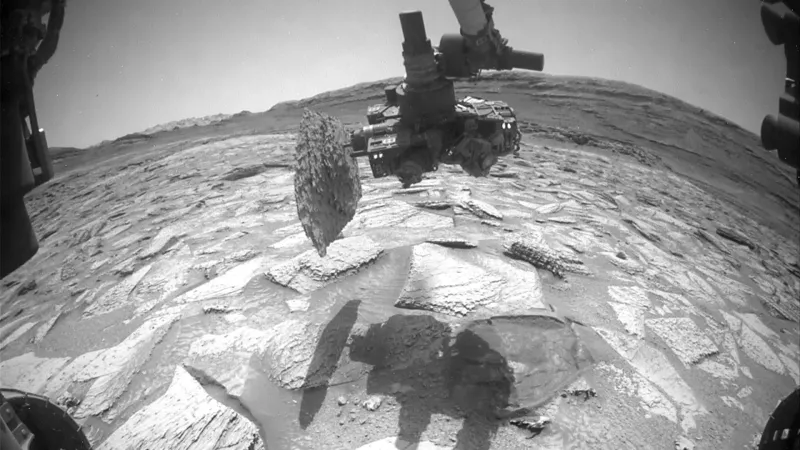
On May 30, 2024, NASA's Curiosity rover made an unexpected discovery while driving through the Gediz Vallis channel on Mars. The rover's weight caused a rock to crack open, revealing yellow sulfur crystals inside—a first for the mission.
The discovery was captured by Curiosity's Mast Camera (Mastcam) and later confirmed by the rover's Alpha Particle X-Ray Spectrometer (APXS), which identified the material as elemental sulfur. Previously, sulfur compounds had been detected on Mars, but never in pure, crystalline form.
Curiosity had been exploring a region rich in sulfates, but the presence of pure sulfur suggests a different geological process, possibly involving volcanic activity or hydrothermal vents. The find has excited scientists, as it provides new clues about Mars' ancient environment and its potential to have supported microbial life.
The rover continues to analyze the area, with plans to drill into nearby rocks for further study. This accidental discovery highlights the serendipitous nature of planetary exploration.