Researchers have developed a closed-loop virtual reality system to validate a three-dimensional model of social coordination in fish. The study, published in a peer-reviewed journal, used real-time feedback to present virtual fish to real fish, which responded with natural swimming behaviors, confirming the model's accuracy.
The system tracks the movement of a real fish and projects a computer-generated fish that reacts in real time, creating a closed loop of interaction. This approach allows scientists to isolate and test specific social cues without confounding variables from live animals.
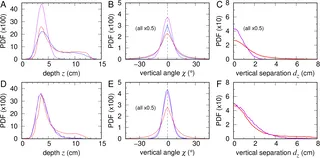
According to the study, the virtual fish elicited the same collective behaviors as real fish, such as schooling and alignment, supporting the model's predictions. The findings could help researchers better understand collective behavior in animals and inform robotics and autonomous systems.
The research was conducted by a team from [Institution], and the paper was published on [Date]. The authors note that the closed-loop methodology can be extended to other species and social contexts.