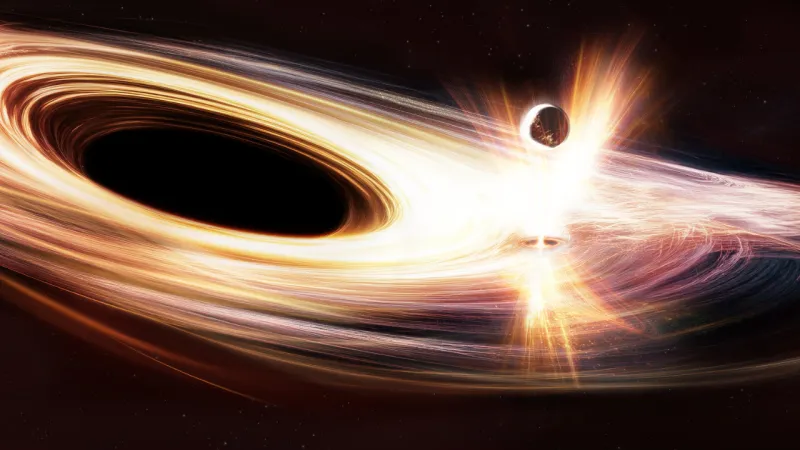
Astronomers have long observed that black holes can launch powerful jets of plasma, but the exact conditions that trigger these outbursts have remained unclear. Recent research has provided new insights into the timing of these events, linking them to the accumulation of matter in the accretion disk.
According to a study published in a leading journal, the key factor is the strength of the magnetic field in the inner region of the disk. When the magnetic field becomes strong enough, it can extract energy from the black hole's rotation and launch jets. This process, known as the Blandford-Znajek mechanism, was first proposed in 1977 but has now been confirmed by detailed observations.
The study used data from the Event Horizon Telescope and other observatories to track the evolution of jets in several active galaxies. The researchers found that jets are launched shortly after a sudden increase in the accretion rate, which strengthens the magnetic field. This discovery helps explain why some black holes are active while others are dormant.
These findings have important implications for our understanding of galaxy evolution. Jets can inject energy into the surrounding interstellar medium, affecting star formation and the growth of galaxies. Future observations with next-generation telescopes will further test these models.