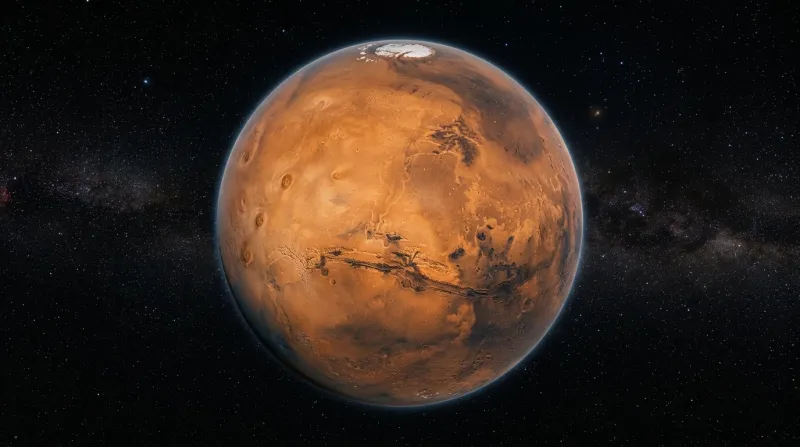
A dark rock, slightly heavier than a smartphone, once forgotten in a collector's drawer, has become the centerpiece of a scientific revolution. Known as Black Beauty (officially Northwest Africa 7034), this Martian meteorite has been hiding a secret for 4.4 billion years: evidence of water on early Mars.
Recent studies, published in 2024 and 2025, have analyzed zircon grains within Black Beauty. These grains contain traces of water, suggesting that Mars had liquid water on its surface just 100 million years after the planet formed. This finding pushes back the timeline for habitable conditions on Mars, making it a key target for understanding the planet's potential to support life.
The meteorite, weighing about 320 grams, was discovered in the Sahara Desert in 2011. It is the oldest known Martian meteorite, and its unique composition has provided scientists with a rare glimpse into the Red Planet's ancient crust. The water signature found in the zircons indicates that Mars was not always the arid desert we see today.
This discovery has profound implications for astrobiology and planetary science. It suggests that Mars may have had a warm, wet environment early in its history, potentially capable of hosting microbial life. Future missions, such as the Mars Sample Return, aim to bring back more samples to further investigate these findings.