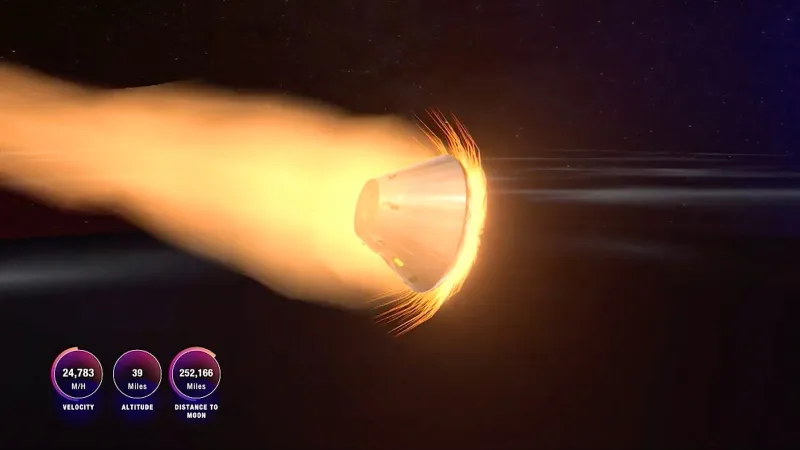
The crew of NASA's Artemis II mission will experience a temporary but expected loss of communication with mission control as their Orion spacecraft reenters Earth's atmosphere. This phenomenon, known as a communications blackout, is a standard part of high-speed atmospheric reentry for spacecraft returning from the Moon.
The blackout occurs when the spacecraft is enveloped in a superheated plasma sheath, created by the compression of atmospheric gases. This ionized gas blocks radio signals for several minutes. For Artemis II, this period is anticipated to last approximately four minutes as the capsule slows from about 25,000 mph (40,000 km/h).
NASA and its international partners extensively plan for this event. The Orion spacecraft is designed to operate autonomously during the blackout, controlling its orientation and descent. Communication is expected to be re-established once the spacecraft slows sufficiently and the plasma dissipates, prior to the deployment of its parachutes for a splashdown in the Pacific Ocean.
The Artemis II mission, which will carry four astronauts on a lunar flyby, is a critical test flight before NASA returns humans to the lunar surface. The successful management of reentry and recovery is a key objective for validating the spacecraft's systems for future, longer-duration missions.