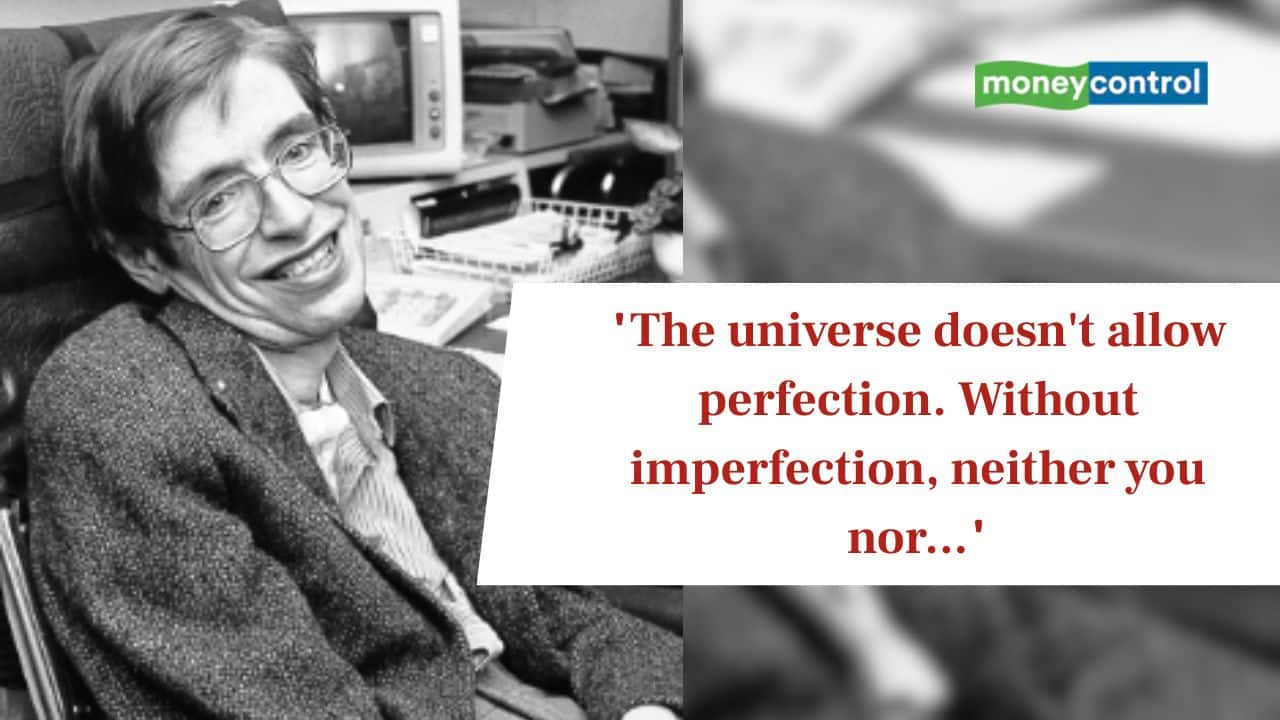
Theoretical physicist Stephen Hawking often explored the fundamental nature of the universe. In various lectures and writings, he discussed how the laws of physics, particularly the second law of thermodynamics, rely on imperfection and asymmetry. He argued that a perfectly ordered, symmetrical universe would lack the conditions necessary for the emergence of complex structures, including life.
Hawking's perspective connects to cosmological concepts like entropy, which measures disorder. The universe began in a state of low entropy, and its increase over time drives the formation of galaxies, stars, and planets. This necessary progression from order to disorder is a form of cosmic imperfection that enables existence.
His famous quote, "The universe doesn't allow perfection," underscores this idea. Without the initial imperfections in the density of the early universe, matter would not have clumped together to form galaxies. Similarly, biological evolution depends on genetic mutations—imperfections in replication—that drive diversity and adaptation.
Thus, Hawking's view presents imperfection not as a flaw, but as a foundational principle. It is the reason the cosmos is dynamic and varied, and why beings capable of contemplating it can exist at all.