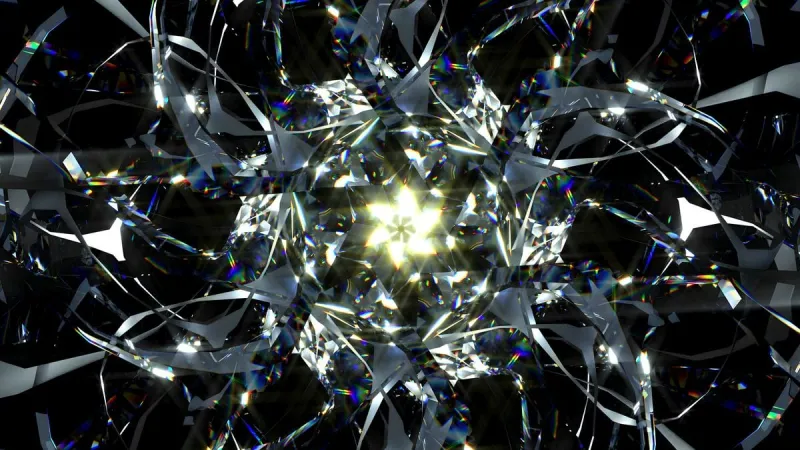
A recent theoretical paper explores the possibility that spacetime crystals—exotic structures that form at the boundary of black hole formation—could collapse into tiny black holes. The study, published on the preprint server arXiv, examines how spacetime can become highly structured near the point of gravitational collapse, leading to crystal-like patterns in the fabric of spacetime itself.
Spacetime crystals are a theoretical concept where the geometry of spacetime exhibits periodic patterns, similar to atomic crystals but on a cosmic scale. The researchers propose that under extreme conditions, such as those near a forming black hole, these patterns could become unstable and collapse, potentially creating microscopic black holes.
The paper does not provide experimental evidence but offers a mathematical framework for understanding these exotic phenomena. It builds on previous work in general relativity and quantum gravity, suggesting that spacetime crystals might be a bridge between classical and quantum descriptions of gravity.
While the idea remains speculative, it highlights the ongoing efforts to understand the nature of spacetime at the most extreme scales. The study has not yet been peer-reviewed, but it has generated interest among physicists for its novel approach to black hole formation.