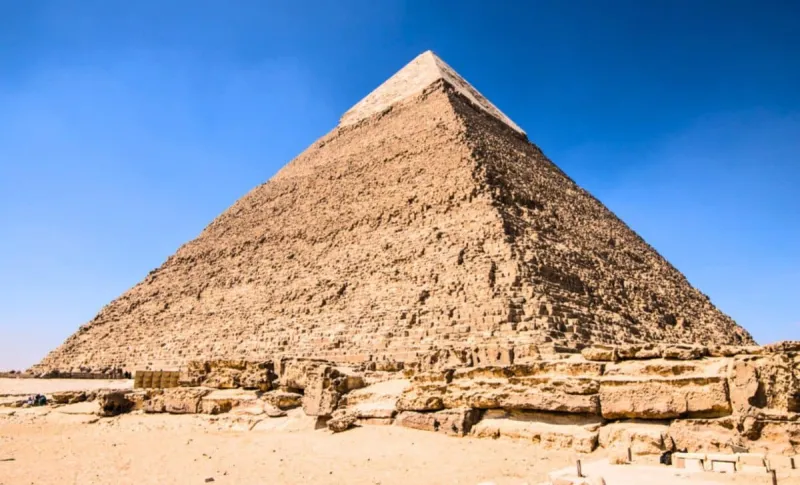
An international research team has confirmed the existence of a significant, sealed void within the Great Pyramid of Giza, also known as the Pyramid of Khufu. The discovery, made using non-invasive muon tomography—a technique that uses cosmic ray particles to peer inside dense structures—was first announced in 2017 and detailed in a 2023 study in the journal Nature Communications.
The void, located directly above the pyramid's Grand Gallery, measures approximately 30 meters (nearly 100 feet) in length. Its cross-section is similar to that of the Grand Gallery below it, but its exact shape, structure, and purpose remain unknown. Researchers from the ScanPyramids project, which includes scientists from institutions in Egypt, France, and Japan, emphasize that the chamber has been sealed since the pyramid's construction around 4,500 years ago.
"This is a premier discovery," said co-author Mehdi Tayoubi of the Heritage Innovation Preservation Institute in 2017. The team used three different muon-detection technologies to confirm the void's presence, ruling out architectural anomalies. The find represents the first major inner structure discovered in the pyramid since the 19th century.
Egyptologists and archaeologists stress that the void's function is purely speculative at this stage. It could be a structural relief chamber, a sealed construction gap, or potentially contain artifacts, though no evidence supports the latter. Further exploration would require minimally invasive methods, and no such missions have been approved as of April 2026.