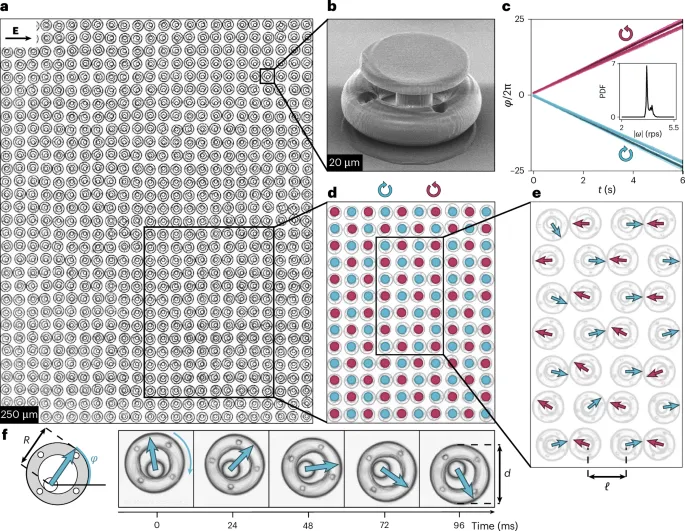
In a study published in Physical Review Letters, researchers investigated how disorder affects wave propagation in arrays of self-propelled micromotors. The work, conducted by scientists at the University of Leipzig and the University of Edinburgh, reveals that phase coherence can emerge without precise programming, mimicking behaviors seen in living systems.
The team used colloidal micromotors that self-propel via catalytic reactions. By arranging them in a ring and introducing random variations in their individual dynamics, they observed that the system spontaneously synchronized into traveling waves. This contradicts the expectation that disorder would disrupt collective motion.
According to the paper, the disorder actually facilitates wave propagation by creating local phase gradients that allow the system to overcome energy barriers. The findings provide a new framework for understanding how biological systems, such as cell colonies or animal groups, achieve coordinated behavior without central control.
Lead author Dr. Frank Cichos emphasized the potential applications: "Our results could inspire new approaches in soft robotics and programmable materials, where self-organization is key." The research was supported by the German Research Foundation and the European Research Council.
This study advances the field of active matter, offering a pathway to design synthetic systems that can perform complex tasks autonomously, similar to living organisms.